
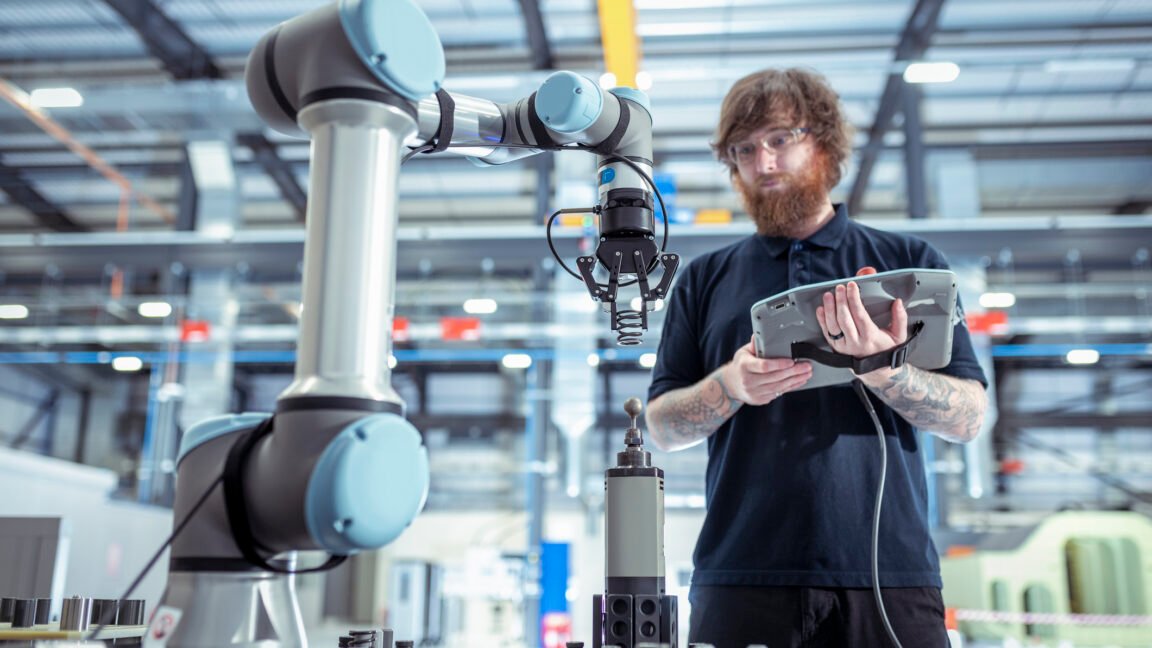
Switching from one smartphone to another is mostly a smooth procedure. You sign in to your accounts and your apps, preferences, and contacts should be synced to the new hardware. But in the world of robotics, replacing an old robot arm with a newer model meant building everything from scratch.
To fix this, a team of researchers at Switzerland’s École Polytechnique Fédérale de Lausanne (EPFL) have developed what they call Kinematic Intelligence, a framework that makes robots work more like smartphone replacements. They describe their system in a recent Science Robotics article.
Demonstrating skills
For years, roboticists have been working on making robots learn by demonstration—teaching them new skills by showing them what to do instead of writing lines of code. The idea is to remotely control the robot’s arm or physically teach it tasks such as wiping a table, stacking boxes or welding a car component. The problem is that most of these taught skills are tied to the specific robot being trained on.
But robotics is developing rapidly. “Robots have different designs, and new designs are being proposed today – which brings its own challenges,” said Sthithpragya Gupta, a roboticist at EPFL and lead author of the study. If the new robot has slightly longer links, a different joint orientation, or a more complex configuration, this learned behavior is immediately broken, and the new robot is likely to slip, freeze, or crash if it tries.
“With new designs come different possibilities and limitations,” said EPFL roboticist and study co-author Durgesh Haribhau Salunkhe. “The challenge is to adapt to these limitations and possibilities—to faithfully reproduce the actions that the human exhibits.” Today, making the leap from one robot body to another usually means starting from scratch and re-engineering the entire system.



