
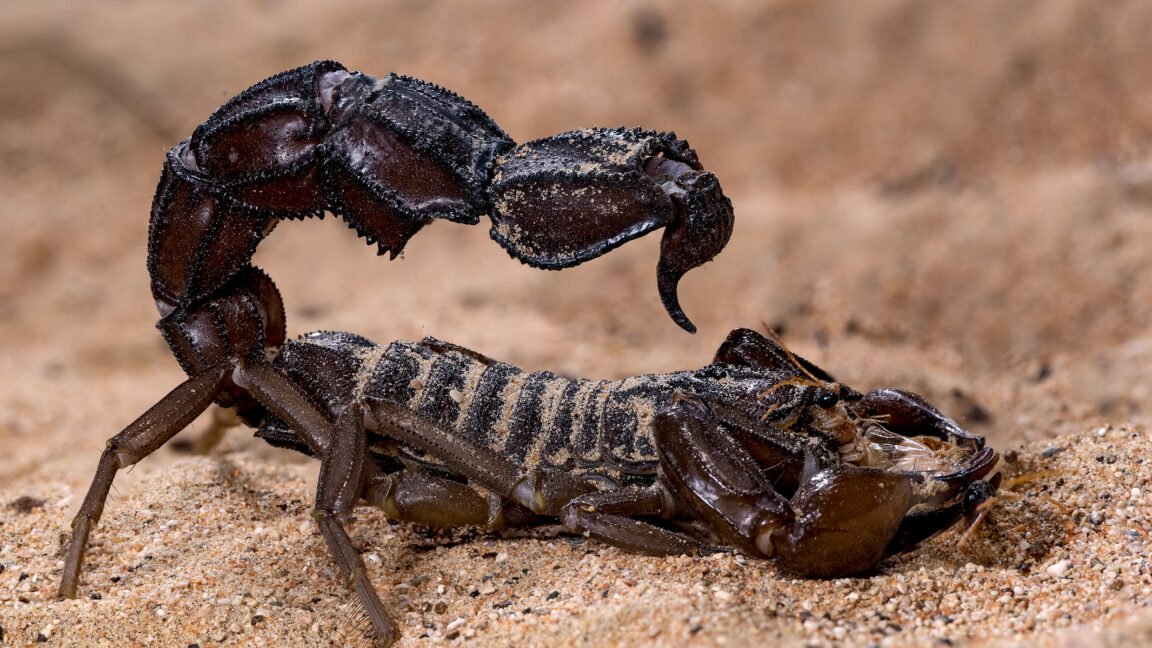
One idea floated by the team is that zinc and manganese are limited resources, so scorpions can only strengthen the most important parts of their stingers, rather than spreading the metals throughout their exoskeletons.
Delving deeper into what appears to be a design flaw in an otherwise neatly built stinger is something Campbell wants to focus on in the future. But the team thinks there’s more to learn.
“We were using museum specimens and only picked one of each species,” Campbell said.
A disadvantage of this approach is that the study did not capture variations in metal enrichment patterns between different individuals of the same species. Campbell acknowledged that these changes can be significant in scorpions, which generally have strong sexual dimorphism—females are typically larger than males.
Another point the study did not address is whether metal enrichment changes over the life of the scorpions. Scorpions go through several molts, shedding their exoskeleton to grow and move to a new stage or instar. “There was a study that showed there was no metal enrichment when the first-stage scorpion was born,” Campbell said. “The metal starts coming to the needles by the second cycle.”
According to Campbell, the difficulty in answering such questions is that scorpions are so difficult to study. They are nocturnal, often living in deserts and burrowing underground.
“We don’t know 100 percent what their behavior is,” Campbell said. “It would be nice to make a real connection between what we observe in the wild, how they interact with their environment, and what we find in their exoskeletons in the lab. That would be a great, great study to try.”
The team’s study of metal enrichment in scorpions’ arms is published in the Journal of The Royal Society Interface: https://doi.org/10.1098/rsif.2025.0523



