
Bek Ventures, Laton Ventures and angel investor Mert Gur returned. Total funding for the two-year-old studio reaches $103 million. The round comes weeks after Scopely’s $1 billion acquisition of Loom Games and CVC’s $5 billion deal for Dream Games.
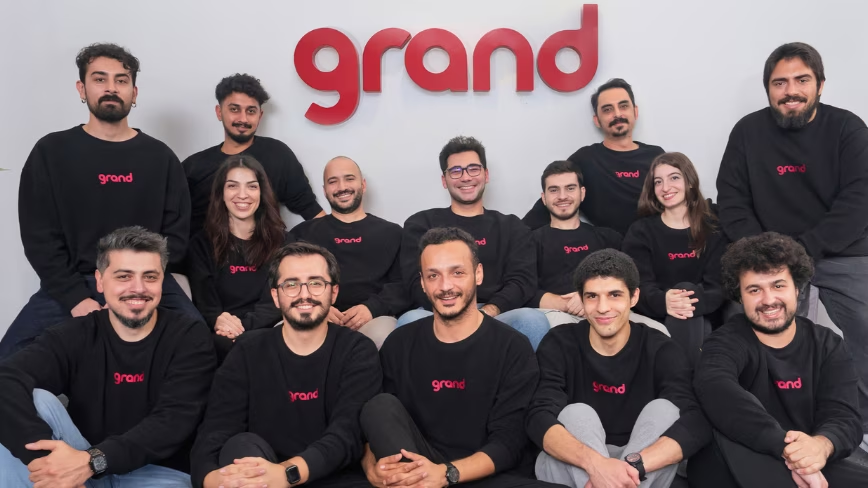
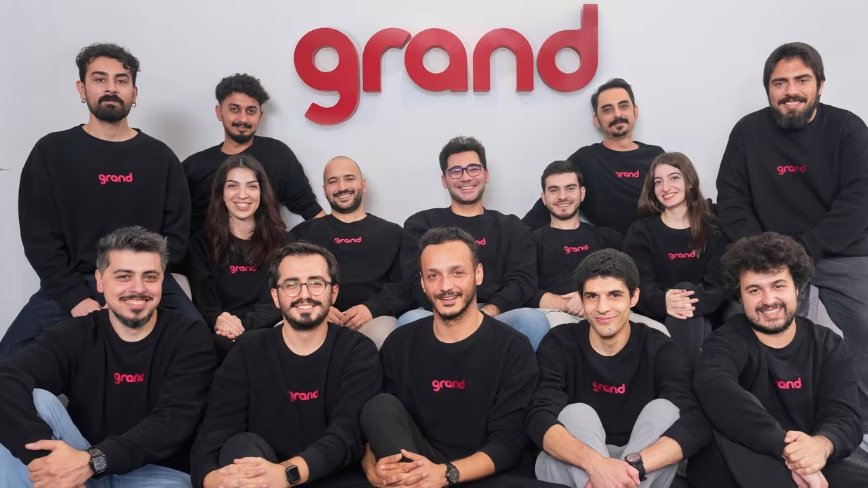
Grand Games Oyun ve Yazılım, the Istanbul-based mobile game studio behind Magic Sort and Car Match, has raised $70 million in a Series B funding round led by Balderton Capital’s Growth Fund.
Bek Ventures, Laton Ventures and angel investor Mert Gur participated alongside Balderton, which doubled its January 2025 Series A position.
The latest round brings the Grand Games’ total funding to $103 million.
Grand Games was founded in early 2024 at Moon Active by the team that previously built Zen Match. Magic Sort, the studio’s first commercial title, entered Apple’s best-selling casual game charts within six months of its release.
Its second title, Car Match, followed shortly after. By the time Series A closed in January 2025, the two games were generating a combined gross app revenue of $4 million per month.
Although Grand Games did not disclose updated figures, Series B shows that the revenue trajectory is continuing.
The round reaches the Turkish gaming market, which has generated more positive M&A news than any other startup category in the country over the past six months.
Scopely acquired a majority stake in Loom Games in March for more than $1 billion, less than a year after the studio was founded. CVC took a strategic position in Dream Games worth about $5 billion.
Both deals followed Zynga’s earlier $1.8 billion purchase of Peak Games in 2020, a transaction that was widely hailed as the start of Istanbul’s gaming scene. Investors are betting that the same playbook, mobile-casual studios run by graduates of previous Turkish gaming successes, will continue to merge.
Grand Games is the direct successor of this generation. Balderton announced a $1.3 billion vintage last yearIt backed Dream Games in Series A and now expresses the same faith in its successor.
The structural reasons behind Turkey’s mobile gaming concentration are well-rehearsed, but worth repeating: a deep technical and creative talent pool centered around a network of Peak alumni, a local cost base that allows small teams to produce global-quality products without the wage structures of Western Europe, and a regulatory environment that is at least more amenable to companies in other sectors.
The Turkish government announced earlier this year that it would cover half of mobile game development costs under a new incentive program, further accelerating the formation.
Bloomberg’s report on the Big Games round touts the deal as evidence that this incentive structure is starting to pay off at the venture capital level.
For Grand Games in particular, the use of funds is conditional: recruitment, additional title development and user acquisition are spent on the highly leveraged mobile channels where puzzle and casual studios compete most fiercely.
The studio is said to be working on additional titles in the pouring-puzzle and car-customization genres, both of which have demonstrated commercial viability in mobile casual games. The competitive set is crowded but comfortable.
Peak, Dream and Spyke all operate adjacent franchises; The global mobile casual game market is estimated to reach $32 billion in 2025, according to Newzoo’s estimates, with Turkish studios responsible for a large share.
The numbers underlying the round will provide growth fund metrics, not venture capital.
Balderton Growth Fund II, raised as part of a $1.3 billion vintage paired with Balderton’s $615 million Series A in 2024, targets European companies between Series B and IPO. Grand Games in Series B is the stage the fund is meant to support, and doubling down on an existing portfolio company is a pattern Balderton has replicated between Dream Games, Revolut and Wayve.
The implicit thesis is that the same firms that achieve great early-stage results can be sustained through growth, provided they continue to deliver on metrics.
This logic works particularly well in mobile casual games, where the unit economy is unusually transparent. A studio either has a title that refunds user acquisition costs over a twelve-month payback period, or it doesn’t. Grand Games’ published revenue trajectory bears this out.
Thus, Series B bets less thesis than the continuation of a task that has already paid in the public app store charts. Pricing not disclosed; comparable Turkish casual game Series B and growth periods generally fell in the range of $400 million to $800 million based on current operations and analyst commentary.
What the Grand Games will do next is a more interesting variable. After the Series B, the most common path for the Turkish casual game studio has been a multi-year preparation for a strategic acquisition of one of the US-listed game consolidators.
Zynga (now owned by Take-Two), Scopely, Playtika, MTG and Embracer have completed deals in this category in the last six years.
The buyer list matters less than the structural model: studios that reach $200 million or more in recurring revenue tend to be acquired rather than remain independent, in part because global publishing and platform deals offered to a portfolio company are more lucrative than those available to a studio operator.
The Grand Games is not yet at that scale, although the trajectory that the B Series envisions is well suited to get there. If the studio continues to ship titles at the cadence its founders have hinted at, a run rate of $200 million over twenty-four months is plausible, not ambitious.
Whether the end result is an acquisition or an independent run depends on the founders and how the IPO window looks in the late 2020s. The current window is open enough that optionality is important.
In the near term, the circle points to two things. First, the Turkish mobile gaming pipeline behind the unicorn title results is original and creating the next wave of investable companies.
Second, European growth capital is willing to write meaningful checks to that pipeline at valuations that global category leaders can write.
Both are useful data points for the broader question of whether Europe’s deepest pockets of tech capital can coalesce around a particular sector over long enough to produce multibillion-dollar results.
Based on the available evidence, mobile casual gaming is closer to producing this work than most other European technology subsectors.
Grand Games’ $70 million is the latest line on that chart. The next one is somewhere on the studio’s product roadmap.



