
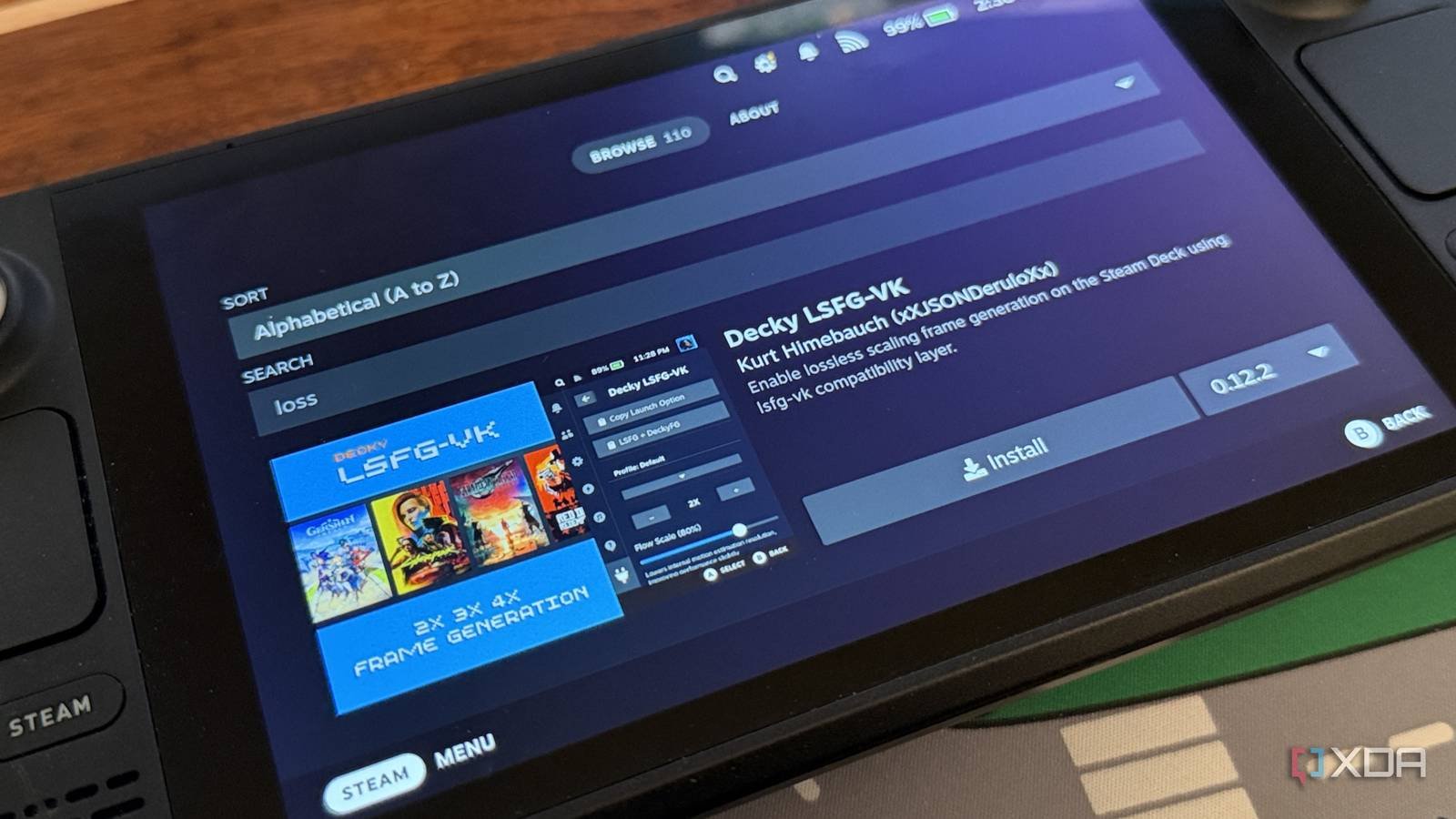
It’s no secret that I love Steam Deck, and that’s one of the things that makes it even better Plugins provided by Decky Loader. Better on more powerful hardware Like the ROG Ally X if you install SteamOSbecause it gives you more computing power to run your games, in addition to Linux’s lower resource usage..
But let’s go back to Steam Deck for a moment, because it doesn’t support one of the things that more powerful gaming hardware does – frame generation. It’s a shame because it could really benefit from a x2, x3 or x4 framegen at times, allowing you to run more graphically intensive games at smoother framerates or lighter games at higher framerates.
Or at least you couldn’t. thanks to a program called Lossless Scaling and you can use framegen on Steam Deck with a plugin for Decky Loader that converts Windows DX11 calls to Vulkan. I should warn you that it’s a work in progress with glitches, limited game compatibility, and a still somewhat annoying installation process, but it’s a huge step forward from where it was before.
Wait… Does Lossless Scaling work on Steam Deck?
Yes, but Proton is not decisive here

Lossless Scaling worked on Linux Since early 2025, an open source developer has released lsfg-vk, which translates DirectX 11 calls to Vulkan with DXVK. It’s also a core component of Proton, so it gives you half of the Linux support you need. The other half was rewriting the shader pipeline in DX11 so it could be converted.
The first step to convert D3D11 to Vulcan is to not convert D3D11 to Vulcan. Instead, you need to convert D3D11 to D3D11 and then to Vulcan.
The end result is a chain of transformations that enable Lossless Scaling to work on Linux. Yes, that includes the Steam Deck, though its installation and commissioning process was fairly involved. But not anymore, because there’s a plugin for Decky Loader that gives you useful GUI controls that you’ll need to get started.
You will need the plugin and the main program
You don’t get anything for free, not even fake frames, and you’ll need to purchase Lossless Scaling on Steam to get started. Decky Loader and Decky LSFG-VK plugin are both free and don’t take much time to install. Decky Loader can be a tricky part because you have to match the version Stable or Beta It’s a branch of SteamOS, and it tends to crash when SteamOS gets an update, forcing you to go back to desktop mode to reinstall Decky to get back to where you were.
The Decky plugin takes all the pain out of LSFG-VK configuration
You only need to add one small command to your games launch command
Installing plugins in Decky Loader it’s a simple process with a few taps, but you need to install Lossless Scaling first. I didn’t read the instructions the first time, so the screenshots above have the angry red reminder, but after a quick install, it turned green.
Then click Install lsfg-v lsfg-vk button to build the Vulcan layer that handles translations. This step was frustrating to do manually, requiring you to type in where the dll file for Lossless Scaling is installed, along with a few other things that are more difficult to do in Steam Deck.
To finish, you set basic configuration settings from the Decky plugin GUI, so you don’t need to type any startup commands anymore.
- FPS Multiplier: Choose between 2x, 3x or 4x frame generation
- Stream Size: Adjust motion estimation quality (low = better performance, high = better quality)
- Performance mode: Uses a lighter processing model – recommended for most games
- HDR mode: Enable for games that support HDR output
Once the plugin is installed and configured and both the Lossless Scaling and lsfg-vk reminders appear in green, all you need to do is add a short command to the startup options of each game you want to use. Steam Deck uses Vulcan for games anyway, so you don’t need to fix a lot of other things, assuming the game is compatible.
Using Lossless Scaling is now easy

Assuming your game is compatible, it’s fairly simple to run this game by creating a frame. You add ~/lsfg %command% to launch options for each game you want to use, so you don’t have to do anything but run the game in the future. It is useful Copy Startup Option button in the plugin to copy the command, so you can easily paste it with the Steam Deck keyboard and then launch your game.
The only other thing to change are the in-game settings, you might want to Full screen windowed, otherwise the Lossless Scaling software may not connect to the game and give you the expected fps.

This is still a work in progress
Not every game will work (and Decky can be buggy too)

I’ve been testing different games and it’s a little confusing which one will work. Deep Rock Galactic: Survivor It actually lost frames with this, as the game would regularly run at 70-80 fps without Lossless Scaling enabled, dropping to 58-60 fps with it. I know it connected to the game properly because it was flickering while loading so I’m not sure what’s going on.
Likewise, Elden Ring is a game we managed to run on a Linux desktop using the non-Decky version of the tool, and I didn’t notice any change in frame rate while running around The Lands Between.
There is real A laundry list of quirks and tweaks Try to get Lossless Scaling to work with individual games and some will be trial and error. I’ve run it on Linux so I know it’s possible, but tuning for Steam Deck will take more time.
Decky Loader is very fluffy, but Lossless Scaling is not
While most plugins for Decky Loader involve changing the UI for SteamOS, Lossless Scaling actually benefits the game. Or at least it promises if you can figure out which games work. It’s still early days, and like everything with Linux gaming, more work may be needed to make it a smoother experience. Until then, nothing can stop you from trying out your favorite Steam games to see if you can get a nice boost in frame rates.

- Dimensions
-
11.7 x 4.6 x 1.9 inches (298 mm x 117 mm x 49 mm)
- Weight
-
1.41 pounds (640 grams)



