

TL;DR
SpaceX’s Starship V3 deployed dummy satellites, but lost its Super Heavy booster in an explosion. The $75 billion IPO is three weeks away.
SpaceX conducted the 12th test flight of its Starship rocket from Starbase, Texas on Thursday, debuting the upgraded Version 3 vehicle. The flight successfully deployed 20 fake Starlink satellites and broadcast live video from space, but The Super Heavy booster was destroyed after separation, unable to achieve a controlled landing. The test comes three weeks before SpaceX is expected to raise about $75 billion in what would be the largest IPO in history.
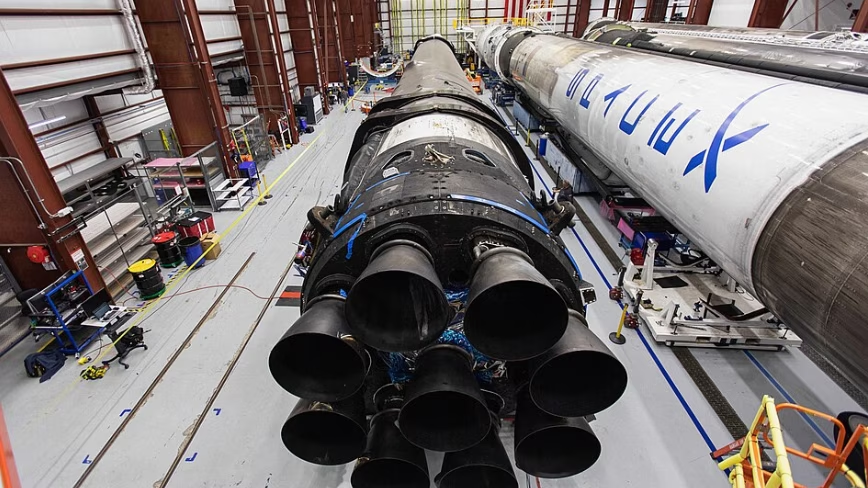
The 90-minute launch window opened at 6:30 p.m. ET the previous day after a scrub caused by a hydraulic pin on the launch tower failing to retract. Starship V3 lifted off from the new launch pad at Starbase, powered by 33 Raptor engines generating 18 million pounds of thrust. The vehicle is 408 feet tall when fully assembled and is the largest rocket ever built or flown.
The flight nominally continued through liftoff and phase separation, but anomalies appeared almost immediately after the Super Heavy booster separated. Failures during an engine relight sequence designed to direct the booster into a controlled descent resulted in a loss of control, disabling a significant portion of the booster’s rear section. The booster did not attempt to land on the launch tower on this flight, but aimed for a controlled landing in the Gulf of Mexico.
The upper stage, designated Ship 39, continued on a suborbital trajectory despite losing one of its six engines during the violent takeoff. It deployed 20 mock Starlink satellites one by one, plus two actual modified satellites equipped to scan the spacecraft’s heat shield and transmit data back during landing. After reaching a speed of Mach 7, the Starship ignited its two engines before diving vertically into the Indian Ocean, where it overturned and exploded upon contact with the water, an expected outcome for its test profile.
SpaceX has spent more than $15 billion on the Starship programaccording to an IPO prospectus filed on Wednesday. The company called Starship “It is designed to deliver a 100 metric ton payload into Earth orbit in a fully reusable configuration while providing rapid turnaround times similar to commercial aviation.” Full reuse requires the return of both the upper stage and booster intact.Friday’s flight was unsuccessful, although it demonstrated that the main mission profile, satellite placement from a suborbital trajectory, works with V3 hardware.
IPO prospectus approved Elon Musk owns about 42% of SpaceX’s equity, but controls about 79% of the votes through a dual-tier share structure. The company, which merged with Musk’s artificial intelligence startup xAI in February, was valued at $1.25 trillion. It is now targeting a valuation of US$1.75 trillion for the public listing, with 21 banks underwriting syndicates and a global road show expected to begin the week of June 8.
NASA Administrator Jared Isaacman flew to Starbase before the launch and appeared in a flight suit with SpaceX employees on the company’s live broadcast. Isaacman, who commanded two private SpaceX missions before leading NASA, has a close personal relationship with Musk. NASA is relying on a modified Starship to land astronauts on the Moon in 2028 as part of its Artemis program. Friday’s booster failure does not directly affect the Artemis schedule, but it does indicate that the V3 vehicle’s propulsion systems require further development before crewed flights can be considered.
SpaceX, which led the Fram2 polar orbiter mission, has confirmed that private explorer and cryptocurrency billionaire Chun Wang will lead the first Starship flight to Mars. No timeline has been given.
Friday’s test was SpaceX’s first Starship launch in seven months, after a series of explosions and failures caused by falling debris disrupted air travel in early 2025. The company has conducted five Starship test flights against a stated target of 25 in 2025. The FAA has authorized SpaceX to increase its launch cadence at Starbase to 25 per year, and a separate permit issued in February 2026 cleared 44 Starship launches per year at Pad LC-39A in Florida.
Starship is central to SpaceX’s Starlink business model. The company launched more than 3,000 satellites on 122 Falcon 9 missions last year, but Starship is designed to carry and launch significantly more satellites on each mission, providing the scalability needed to serve dense urban areas and support Starlink’s growth trajectory of 10 million subscribers and projected $202 billion in revenue. The IPO comes alongside listings from OpenAI and Anthropiccreating combined demand for more than $150 billion in institutional capital that could reshape public markets.
Booster failure will not stop IPO. SpaceX’s prospectus expressly warns investors that “Starship development involves significant risks, including launch failures“and these test flights may not achieve all goals. Investors who buy SpaceX stock get the Starlink revenue machine and the Starship vision, which is not a guarantee that every test flight will be successful. But the optics of the booster exploding three weeks before the biggest IPO in history are not the flights SpaceX has chosen. Flight 13 is already scheduled for June.



