

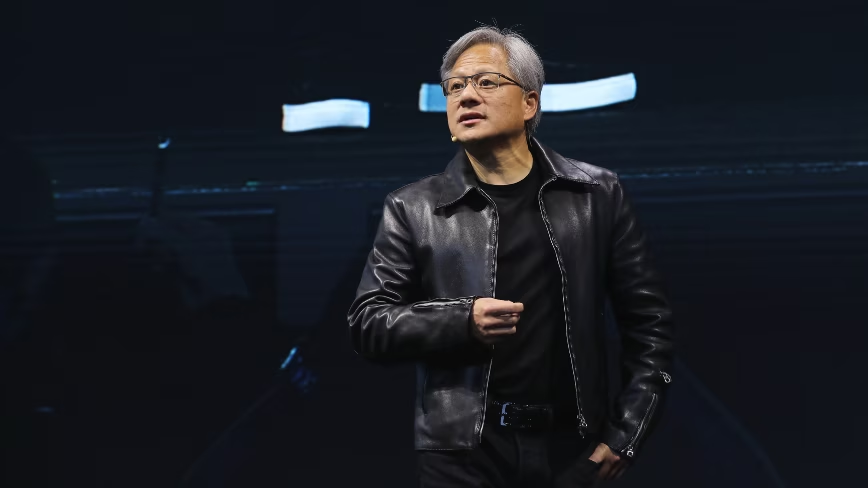
Jensen Huang spent part of his Computex keynote reading the guest list. Anthropic, OpenAI, SpaceX and Oracle are among the first big users of Vera, the company’s new in-house processor, Nvidia’s chief executive told an audience in Taipei on Monday.
The company Nvidia, which built its empire on graphics chips, now wants to be known for CPUs.
Vera is the successor to Grace, Nvidia’s previous data center processor, although the company is positioning it as a major redesign rather than an iteration.
It’s built around about 88 of Nvidia’s own Olympus cores, as opposed to the off-the-shelf Arm Neoverse cores that power Grace, and the company says it’s currently in full production.
The point is that Vera is a CPU designed for the age of artificial intelligence agents, a program that schedules and executes tasks rather than simply responding to a request. Nvidia claims the chip completes these agent workloads faster than x86 processors made by Intel and AMD, and pairs the cores with 1.2 TB/s of memory throughput.
Early standalone benchmarks put Vera ahead of Intel’s Xeon and AMD’s EPYC by several measures, which is the comparison Nvidia wants to draw.
Named customers are as important as silicon. Anthropic and OpenAI are two labs whose computing appetites have come to define the current build, and Nvidia listing them as launch users is a statement about where the chip is headed.
According to Nvidia’s own account, the first devices were hand-delivered in May, before the public announcement in Taipei.
For Nvidia, the CPU is a flank maneuver. Its GPUs are already at the heart of nearly every major AI system, and the data center processor has long been a key component it buys rather than builds.
Its design eliminates dependencies and allows the company to sell the CPU and GPU as a compatible pair, which is the logic behind the Vera Rubin platform. Huang calls it the biggest product release in the island’s history.
Huang spent the year illustrating Taiwan as the “epicenter”. of this effort.
Oracle Cloud Infrastructure will be the first hyperscaler to deploy Vera at scale, with wider availability in other major clouds expected in the second half of 2026. This is a number worth watching on the graph.
A podium filled with full production and marquee names is easy to announce in June; It’s harder for paid customers to carry volume and they’re still ahead.
What Nvidia didn’t say in Taipei was pricing, or how many units any of the labs mentioned actually committed to. The guest list was read. There were no invoices.



