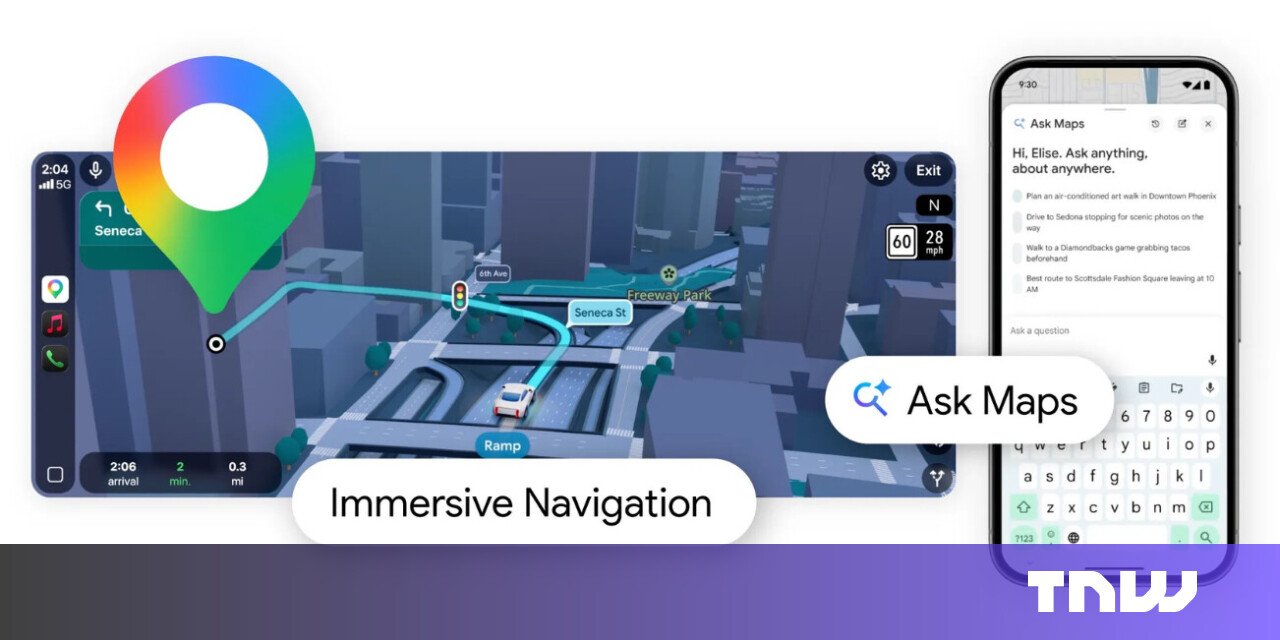
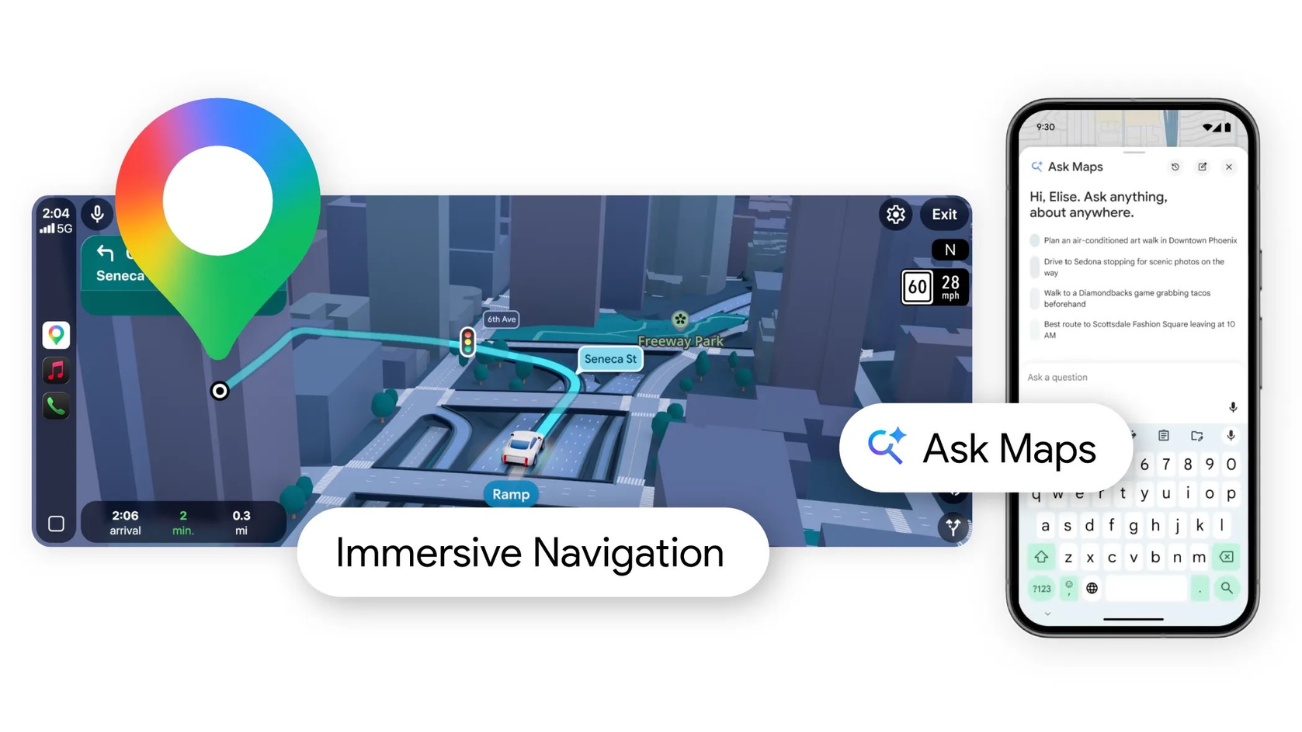
Ask Map allows users to query the world in natural language. Immersive Navigation recreates directions in 3D. Together, they mark the most significant overhaul of Google Maps since Street View.
Google is now asking its users to ask Maps: “My phone is dying, where can I charge it without waiting too long for coffee?” The fact that navigation software can handle this request and actually respond well to it represents a meaningful shift in what digital cartography can do.
Google announced Ask MapsPowered by Gemini, it brings photorealistic 3D imaging to turn-by-turn directions, along with conversational AI functionality and a redesigned Immersive Navigation experience. The merger represents what Google is calling its most significant Maps update in more than a decade, though it has been reluctant to say so directly.
Ask the Map works by allowing users to make complex, contextual queries instead of searching for a specific location or category. “Is there a public tennis court with lights that I can play tonight?” Here’s an example offered by Google in a blog post published on March 12.
The system uses personalization signals, including the user’s saved locations and past searches, to evaluate its answers, so a user who has previously searched for vegan restaurants will find vegan-friendly options without specifying.
The feature is currently available on Android and iOS in the US and India, with a desktop version coming soon. Google has not given a timetable for further international expansion.
3D reconstruction
The second major component of the update, Immersive Navigation, replaces the current flat map navigation overlay with a 3D view that includes nearby buildings, overpasses, and terrain. Lane markings, traffic lights, crosswalks, and stop signs are presented as visual cues rather than textual instructions.
The voice guide has been updated to use cues such as “Take this exit and take the next exit for Illinois 43 South” rather than distance-based directions.
The redesign brings Google Maps closer to the long-standing visual approach of Apple Maps, which introduced detailed 3D city imagery a few years ago. Google is only now implementing comparable depth in navigation, also reflects both the computational cost of real-time 3D rendering on mobile devices and the time needed to build the underlying map data at sufficient resolution, rather than the existing Immersive View, which is a non-navigation mode.
Competitive context
Ask a Map is the most direct integration of Google’s Gemini AI into a product used by more than a billion people every month. Until now, Gemini’s presence on Maps was limited to AI-powered summaries of places and reviews. Query Maps extends this to full conversational navigation, putting Google in more direct competition with AI tools like Perplexity, which builds search-style answers to location-based queries into its products.
The update also comes as Apple deepens its Maps intelligence and explores OpenAI’s location-aware features in ChatGPT. For Google, which derives a significant portion of its ad revenue from local search queries, maintaining Maps as the dominant interface for spatial intent is critical. Ask Maps is the clearest signal that the company intends to defend this ground.
It’s an open question whether users will actually talk to their maps or just default to the familiar search box. Google has introduced conversational search features before, and adoption has often been slower than product announcements suggest.
But now the infrastructure is ready. The next question is one that users will actually ask.



