
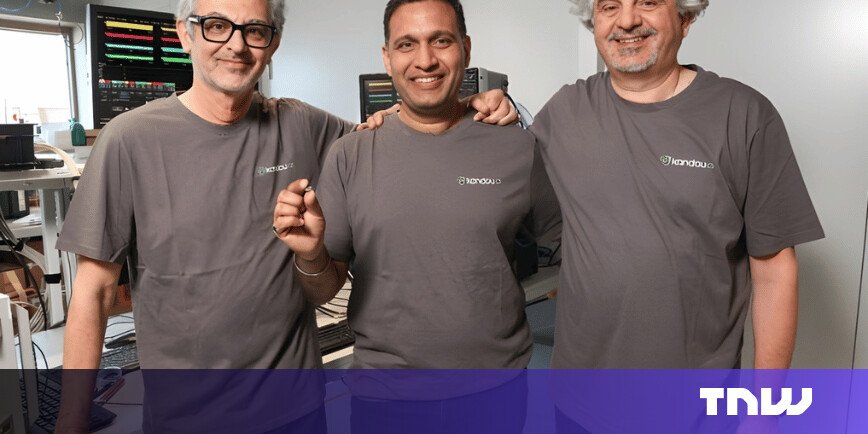
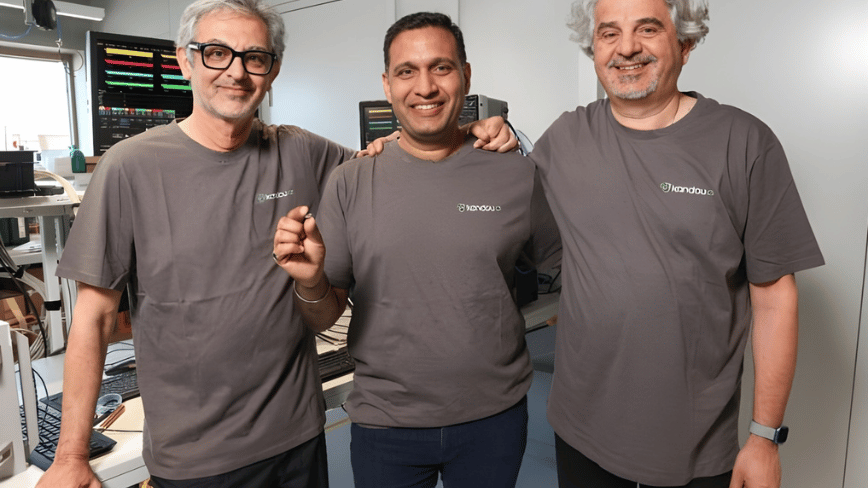
Kandou AI, a Swiss semiconductor developer of chip-to-chip interconnect technology, has raised $225 million in a Series A round led by Maverick Silicon, with strategic participation from SoftBank, Synopsys, Cadence Design Systems and Alchip Technologies. The round values the company at $400 million. Worth a stop tag: Kandou was founded in 2011 and previously raised more than $163 million in Series B and C rounds under the name Kandou Bus. The “Series A” designation reflects a rebrand and a change in leadership, not a fresh start.
The company’s new CEO, Srujan Linga, a former Goldman Sachs managing director, took over from founder Amin Shokrollahi, an EPFL professor of mathematics and computer science who invented the underlying technology in 2025. Shokrollahi’s contribution, a signaling method called Chord, which sends coherent signals across multiple wires to double or quadruple bandwidth while cutting power consumption in half, remains a technical cornerstone. Rebranding Kandou AI and positioning it toward AI infrastructure is Linga’s job, and it seems to have worked: The $225 million raise is the largest in the company’s history and brings SoftBank, one of the most aggressive AI infrastructure investors, on board.
A bet against light
What makes Kandou AI’s position unusual is not the problem it’s trying to solve, but the material it’s proposing to solve it. The interoperability bottleneck of the AI industry is real and well documented. As models scale to hundreds of billions of parameters and training sets expand tens of thousands of GPUsthe speed of data movement between processors and memory has become a binding constraint on performance. At a signal speed of 224 gigabits per second, traditional copper connectors consume about 30 percent of the total cluster power, signal degradation is so strong that the reach without amplification is limited to less than a meter.
The dominant industry response has been to switch to optics. Ayar Labs raised $500 million in March 2026 at a $3.8 billion valuation for co-packaged optical interconnects. Marvell completed its $3.25 billion acquisition of Celestial AI in February, acquiring photonic fabric technology that boosts the bandwidth of copper alternatives by 25 times in one-tenth the latency. Optical interconnect market for AI data centers It is projected to grow from $3.75 billion in 2025 to $18.36 billion by 2033.
Kandou AI is betting that the copper is not finished. The company claims its Chord signaling technology can achieve Shannon-capacity efficiency by extending copper links to 448 gigabits per second and beyond, reducing power consumption and system costs by a factor of ten. If this claim is true, it would mean that the billions spent on optical interconnect links are at least partially premature, and that existing copper infrastructure can be made to work for a few more technical generations at a fraction of the cost.
Strategic investors tell the story
The composition of the investor syndicate is more important than the headline figure. Synopsys and Cadence are two dominant vendors of electronic design automation tools. Their participation is not purely financial; it shows the potential integration of Kandou AI’s serializer/deserialiser intellectual property into the design flows that chip architects use to build processors and memory controllers. Alchip, a Taiwanese ASIC design services company, is leading the way to manufacturing. SoftBank, which has invested more than $100 billion in AI-related companies through its Vision Fund and direct investments, is adding scale capital and a strategic network.
The practical implication is that Kandou’s AI technology could appear inside chips made by other companies, rather than requiring customers to adopt Kandou’s own silicon. It’s a licensing and IP model similar in structure to Arm’s approach in mobile processors, and it’s a more efficient way to dominate the market than directly manufacturing and selling chips. At $400 million and $225 million in fresh capital, Kandou can execute this model against optical rivals valued at ten times the key question.
Evaluation gap
At $400 million, Kandou AI is valued at about a tenth of what Ayar Labs paid and an eighth of what Marvell paid for Gok AI. The gap could reflect market skepticism about the longevity of copper in AI infrastructure, or the fact that Kandou’s technology, if it works as claimed, won’t require the industry to dismantle its existing wiring. Copper is already in every data center. Kandou’s signal technology could make it fast enough for another generation AI workloadsthe acquisition curve would be faster and cheaper than optical switching.
The risk is that the “next generation” may not be long enough. AI model sizes and training cluster scales are growing at a rate that will consistently exceed infrastructure projections. What is adequate today at 448 gigabits per second may be inadequate at the terabits per second speeds that next-generation models will require in two to three years. Optical interconnects, for all their cost and complexity, offer a higher theoretical ceiling.
Kandou AI’s $225 million ceiling is gaining time to prove it can wait. The company’s 15-year history and the technical reliability of Chord signaling, which has been commercially applied in consumer electronics since the mid-2010s, add value to this bet. But the AI infrastructure market has a pattern of rewarding ambition for growth, and a company that claims existing stuff is good enough faces a tougher sell than one that promises to completely replace it. Investors in this round are betting on engineering pragmatism. Whether the market agrees will depend on how quickly the optical switch matures, and whether Kandow’s copper can keep up with an industry that has little interest in waiting.



