
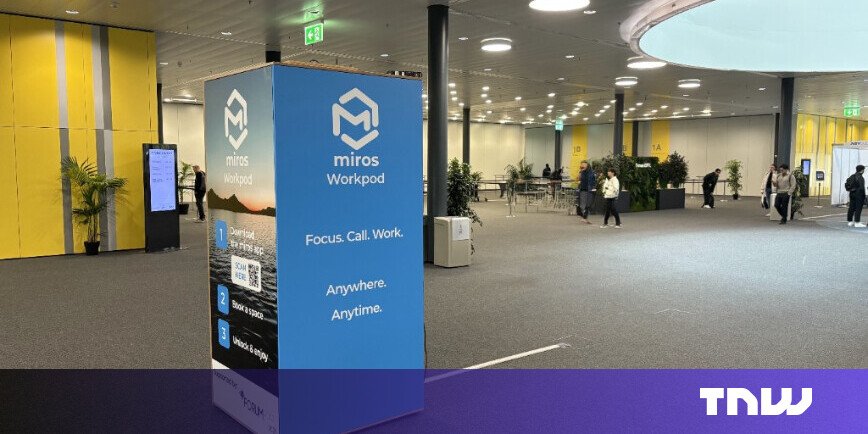
The Lausanne startup, born out of EPFL’s robotics lab, has deployed 15 pods in Switzerland and made its first international foray with a unit in Toulouse. Its founder’s longer-term ambitions: to make commercial real estate itself modular and in-demand.
Problem smell the solution is visible in any busy train station, airport or hospital: people who need to make a personal call, focus on work or have a video meeting and have nowhere to do it.
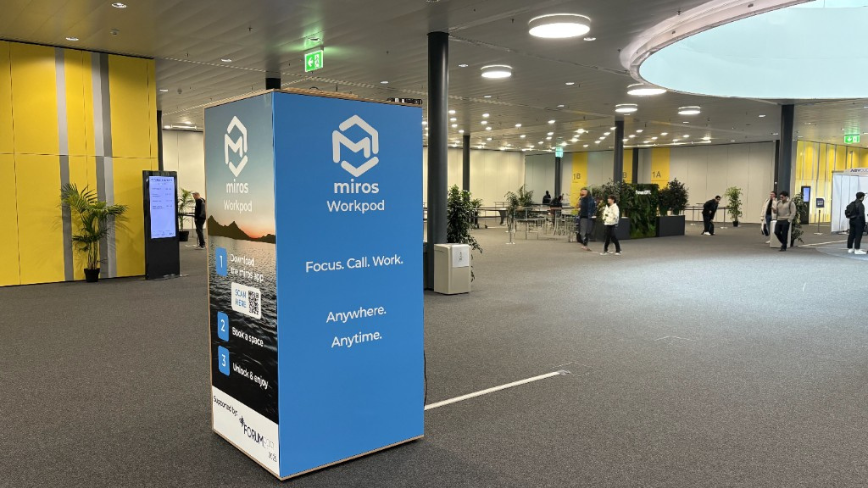
The company builds bookable, connected workspaces, indoor acoustic spaces that users can locate, reserve and unlock via a mobile app, and places them in public and semi-public spaces where such infrastructure has historically not existed.
The Lausanne startup has raised €1.1 million (CHF 1 million) in a seed round from business angels to expand its network.
miros was founded in 2023 by Dr Fabio Zuliani, who completed his PhD at EPFL’s Reconfigurable Robotics Laboratory. The company is part of the EPFL ecosystem built on robotics and adaptive-space research, although its current product is deliberately simple: a well-designed, acoustically private pod that can be placed wherever needed without construction or major installation.
The groups are designed in collaboration with Lacabi, a furniture brand based in Lausanne, and manufactured entirely in Switzerland. The Canton of Vaud additionally supported the development of a version made of Swiss wood (Bois Suisse).
Since launch, miros has deployed 15 workstations and worked with partners including SwissTech Convention Center, Beaulieu and Hôpital Riviera-Chablais. It tested its value proposition at Geneva Airport’s GVA Runway Lab open innovation program, confirming its product-market fit in a real-world setting.
In October, it made its first international deployment, placing a pod in the Village by Crédit Agricole in Toulouse, France. Total usage across all deployments approaches 350 hours. Ducommun’s production partnership with Menuisiers was launched in Vaud through a SyNNergy grant from Innovaud, the cantonal innovation agency.
The immediate use of the initial capital is simple: deploy more pods in Switzerland, aiming for more than 100 units by the end of 2026. However, Zuliani said that the work area is not the final state.
“We start with pods, but the ambition goes far beyond that” he said. “We’re looking at how commercial real estate can be flexible, modular and on-demand. The pod is just the first building block.”
The company plans to announce several new partnerships in the coming months as it expands its footprint in Switzerland.



