
TL;DR
Foundation Future Industries, the San Francisco startup whose CEO runs a formerly bankrupt fintech, has signed a $24 million research contract with the Pentagon to test humanoid robots to disrupt enemy positions. In February, two Phantom MK-1s were sent to Ukraine for logistics and reconnaissance tests. The company’s chief strategy adviser is Eric Trump, prompting Senator Warren to call the contracts “blatant corruption.” The foundation is seeking $500 million at a price of more than $3 billion, but its production goals of 50,000 units from 40 bases by 2027 require a 250-fold expansion, with about $21 million in total funding.
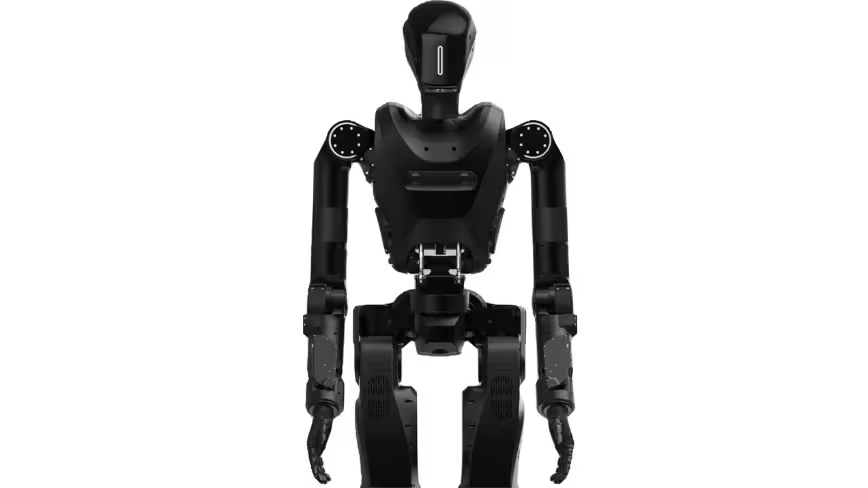
Foundation Future Industries, a San Francisco startup founded in April 2024, has signed a $24 million research contract with the US Army, Navy and Air Force to test humanoid robots designed to disrupt enemy positions. The company’s Phantom MK-1 is a 5-foot-9, 176-pound humanoid with 19 upper-body degrees of freedom, five-fingered hands, a camera-first vision system, and an LLM controllable autonomy stack that combines independent operation with controlled teleoperation. Two units were sent to Ukraine in February for front-line testing in logistics and intelligence, described as the first deployment of humanoid robots to any theater of war. The company is seeking $500 million in new funding, bringing it to $3 billion. His chief strategy adviser is the incumbent president’s son, Eric Trump, a detail that prompted Sen. Elizabeth Warren to call out the Pentagon contracts.blatant corruptiont.” The company’s CEO ran a fintech startup that previously went bankrupt and was unaccounted for with tens of millions of consumer deposits.
Car
The Phantom MK-1 travels at 1.7 meters per second, carries a 44-pound payload, uses eight cameras with no bulky LiDAR, and uses custom cycloidal gears that deliver 160 Newton-meters of torque. Its AI stack drives high-level task instructions through the LLM pipeline, and operators retain ultimate authority over lethal decisions. The unit costs approximately $150,000, and the rental model is $100,000 per year. Expected this month, the MK-2 integrates electronics to reduce the risk of short circuits, adds waterproofing and larger battery packs, increases payload capacity to 175 pounds, and uses die-cast molds to speed production and lower costs. The fund’s production targets are 40 units in 2025, 10,000 units in 2026, and 50,000 units by the end of 2027, with a steady state target of 30,000 units per year. These figures will require a 250-fold increase in production over two years at a total funding base of approximately $21 million.
The company was founded by Sankaet Pathak, who was previously the CEO of Synapse, a banking-as-a-service platform that filed for bankruptcy in 2024; Arjun Sethi, CEO of Tribe Capital, who led the Fund’s $11 million pre-seed round; and Mike LeBlanc, a 14-year Marine Corps veteran and co-founder of Cobalt Robotics. LeBlanc provides military credibility and said the company believes there is a “moral imperative to put these robots into war instead of soldiers.” In June 2024, CNBC reported that the Foundation was raising funds with exaggerated claims of ties to General Motors, including claims that GM had committed to investing and had placed a $300 million purchase order. GM categorically denied all this. LeBlanc confirmed the denial and said he was “embarrassed” by the existence of the marketing materials. For a company asking the Pentagon to trust its robots in battle, the credibility gap is important.
Contracts
The $24 million in Pentagon contracts includes an SBIR Phase 3 designation that identifies the Foundation as an approved military supplier and special research contracts to test humanoid robots in disruption scenarios. Some contracts were inherited through the acquisition of Boardwalk, including a US Air Force SBIR award worth nearly $1.8 million. Eric Trump appeared on Fox Business to promote the deals. Warren’s response was immediate: “Is the Pentagon a money machine for Trump’s children?” The political dimension is inevitable. The current president’s son serves as a senior strategy adviser at a company that receives contracts from the Department of Defense, raising management questions regardless of the company’s technical merits. The contracts are real, but small. Shield AI recently raised $2 billion to expand its autonomous fighter pilotThe artificial intelligence system, called Hivemind, autonomously controls the aircraft and is tested in combat conditions. Anduril won a ten-year, $20 billion contract with the US Army in March for its AI-powered Lattice platform. The fund’s $24 million is a research contract, not a production order. The gap between a research contract and a deployed weapon system is measured in billions of dollars and years of testing.

💜 of EU technology
The latest rumblings from the EU tech scene, a story from our wise founder Boris and some questionable AI art. Free in your inbox every week. Register now!
Ukraine’s placement adds another kind of credibility. The two Phantom MK-1 units sent for logistics and reconnaissance operations in February represent real-world tests in a live conflict zone, and the Foundation is using battlefield feedback to improve the MK-2 design. But “tested in Ukraine” not “deployed in combat”. No humanoid robot has ever fired a weapon in conflict. Units performed support tasks. The distinction is important because the company’s marketing, fundraising and Pentagon contracts all hinge on the idea of a humanoid soldier, and the technology isn’t there yet. NATO-backed ARX Robotics has secured €31 million for autonomous combat robotsground vehicles that perform logistics and reconnaissance without the complexity of bipedal locomotion. ARX Robotics is already increasing the production of autonomous land drones to 1,800 units per year A production reality in a new plant in the UK, where the Foundation’s targets are not yet close.
Controversy
The “Campaign to Stop Killer Robots”, consisting of more than 250 NGOs, has been advocating the creation of a new international legal document since 2013 that would ensure human oversight of the use of force. About 90 countries have requested the creation of such an instrument. A small number of militarized states, including the United States and Russia, prevented its adoption. In November 2025, the First Committee of the UN General Assembly adopted a resolution with 156 states in favor and 5 against. Sessions of the Group of Governmental Experts on Lethal Autonomous Weapon Systems are scheduled for 2026 and are expected to submit a final report to the Convention on Conventional Weapons in November. This is the final year of the GGE’s mandate, making 2026 a make-or-break year for the international regulation of autonomous weapons.
The foundation’s stated policy is that human operators retain final authority over lethality decisions, a “human-in-the-loop” commitment required by Pentagon Directive 3000.09 on autonomy in weapons systems for autonomous and semi-autonomous platforms. But the company’s LLM-driven autonomy stack and claim to “reduce teleoperation needs over time” are in tension with that commitment. Learning to operate more autonomously with each iteration, the LLM-driven task-to-action pipeline is moving toward the autonomous capability that the international community is trying to regulate by design. The battle against artificial intelligence that has made Helsing one of Europe’s most valuable tech firmsestimated at €12 billion for a military artificial intelligence program that coordinates drone squadrons, showing the scale of capital flows into autonomous military systems. Ethics bars are voluntary. Funding incentives point in one direction.
Race
China has demonstrated a motion-controlled humanoid robot for military tasks at an international military cadet event in Nanjing. WuBa Intelligent Tech, backed by state-owned defense conglomerate NORINCO, has secured about $69 million for the RoboWolf quadrupeds. In February 2026, the Pentagon added consumer robot dog maker Unitree to its list of Chinese Military Companies. War on the Rocks has revealed a secret system that turns Chinese technology companies into military suppliers. Viral videos purporting to show off China’s humanoid robot army have been exposed by France 24 as AI-generated hoaxes, but the hoaxes themselves reflect an arms race: the idea of a country building robot soldiers can be as important as the reality in shaping defense budgets and procurement decisions.
Russia has created a new military arm, the Unmanned Systems Force, is deploying the Kurier autonomous mortar system, which loads and fires without human intervention, and is rapidly expanding its ground-based drone fleet in Ukraine. No country has deployed humanoid robots in combat. Military robots actually used on both sides of the Ukraine war and in US border patrol and base security operations are wheeled, tracked or quadrupedal. They succeed because they are simple, cheap and affordable. A bipedal humanoid that costs $150,000 and lands in rough terrain is neither of those things. Defense technology venture capital will reach a record $49.1 billion in 2025, nearly double the previous year, and Goldman Sachs projects 50,000 to 100,000 humanoid robots deployed globally by 2026 across all sectors. Rising defense stocks point to huge potential for military tech startups They created a financial environment where a field of “humanoid robot soldiers” opened their checkbooks. Whether the technology justifies the pitch is a question for the battlefield to answer, and the battlefield so far favors wheels over legs.



