

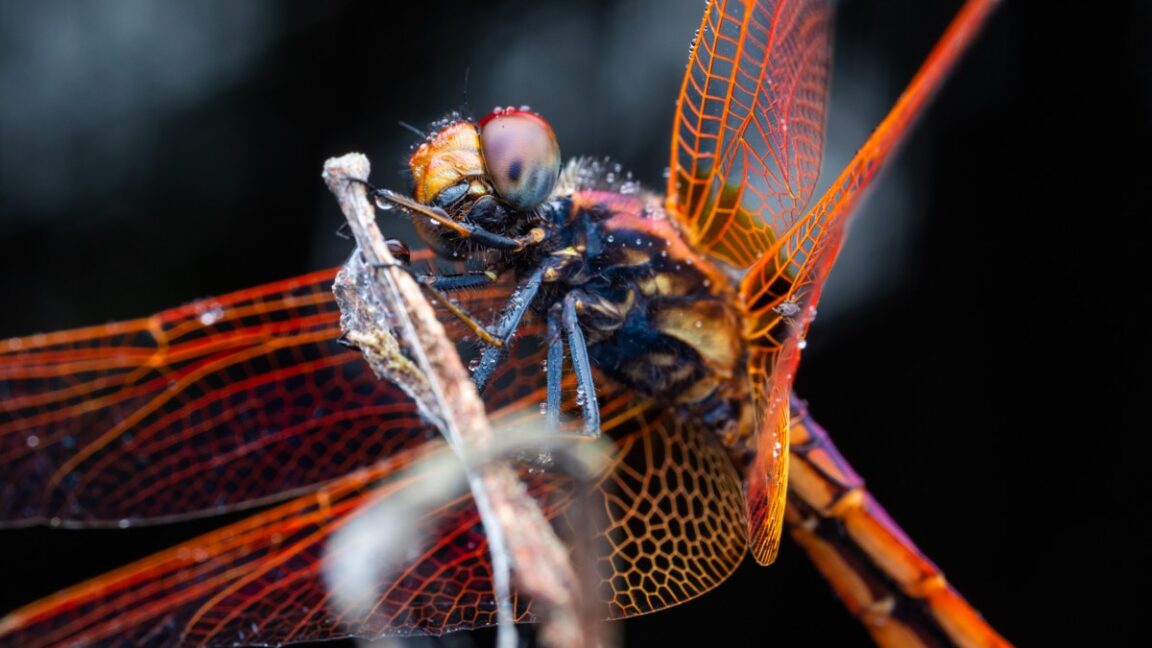
Credit: Samuel T. Fabian et al., 2026
Male dragonflies are known to engage in aerial “dogfights” to protect their breeding territories, using maneuvers different from those of hunting prey. A new paper The study, published in the Journal of the Royal Society Interface, concluded that relatively simple rules govern this behavior, namely that male dragonflies attempt to assume a tactical position. This reflects the tactics of human fighter pilots. The research could lead to the development of smarter drones that can navigate with simple, vision-based guidance rather than complex calculations.
Classical chases involving prey or mating rituals are asymmetrical: there is a pursuer and an escapee, each role requiring different maneuvers. In the case of male-male interactions, it is more mutual pursuit, according to the authors, who believe that studying the flight trajectories of insects or predators can provide useful insights into the guiding laws that underlie the behavior. they chose Trithemis Aurora for the study of dragonfly species, because males are “fiercely territorial” and there are usually multiple males intent on defending their chosen roost around a particular pond. Dragonflies are also dark red in color, making them easy to track.
Most previous studies of dragonfly interactions were based on visual observations or single camera recordings. For this study, the authors set up a portable stereovideography rig with two shutter-synchronized cameras to record dragonfly interactions in both color and monochrome, and then reconstructed 102 paired male-male flight trajectories to capture the 3D kinematics. They also reconstructed nine trajectories of dragonflies catching prey for comparison purposes. This allowed the authors to develop a model for the rules governing flight behavior.
Chasing his tail
The resulting analysis confirmed a marked difference in flight behavior when dragonflies defend their territory from other male dragonflies with “dog fight” displays when they hunt their prey. When hunting, dragonflies approached their prey from below, so the prey was often silhouetted against the sky. Males in dogfights showed more curved trajectories and were viewed more often against a background of foliage or ground.



