
I’ve never had any particular issues with Figma, it’s probably the best design tool on the market. I keep it open most days and most of my coursework and personal projects live there. But I’m always looking for an open source equivalent for any tool I use. There is a penpotVirtually a mirror of Figma, this is my top open source Figma alternative recommendation. However, it is still paid. I recently Came across OpenPencilit’s an incredible open-source Figma alternative with a great AI-powered workflow. But the search did not end there…
Quant-UX appeared on my radar shortly after, even though it has been around for years. It’s a completely free and open source design tool and has several built-ins that Figma doesn’t have.
What exactly is Quant-UX?
Something Figma doesn’t have

Quant-UX is a free, open source tool that handles prototyping, user testing, and analytics all in one place. It runs in the browser so you can sign up and get started without installing anything. There is also an option to self-deploy it if you prefer to run it on your own server, but the hosted version is probably what most people will use, and it’s the same tool either way. It’s been longer than I realized – development started in 2017.
The basic idea is that you build interactive prototypes, share them via a link, and get actual usage data back from the person testing it. So instead of just designing screens, you’re designing something that can be tested. There’s an Examples section with working templates – shopping flows, login screens, dashboards and that sort of thing – really useful if you’re the type to freeze on a blank canvas (that’s me). And it has the usual design system features like tokens, master screens and reusable components, plus a built-in AI assistant with BYOK. If you have existing work in Figma, you can import that too, so you’re starting from scratch (but note that it edits all the layers, so the continuation will be for reference only, not for editing).
The interesting thing about Quant-UX is that it leans more towards the UX research side than anything else. Normally, you’d pair a tool like Maze with Figma for user testing, but Quant-UX actually has it baked in.

The design canvas is a smidge underwhelming
But this is more than workable

I’m not going to lie, I was a little nervous when I first tried the design canvas. The feature set is about half of what I’m used to seeing in a UI/UX design tool. You get the basics—shapes, text, images, basic layout, position and size controls, constraints, borders, simple effects like shadow and blur, and the layers panel—but the deeper controls you’d get in something like Figma or Penpot just aren’t there. Typography controls are pretty slim, the list of presets is pretty short, and there’s no advanced vector editing.
That said, once I actually started building, I realized that I wasn’t getting as much missing stuff as I expected. Canvas covers enough ground to bring real displays together, and what it lacks in design depth it makes up for everywhere else…
Prototyping and testing actually go together
This is where Figma falls short
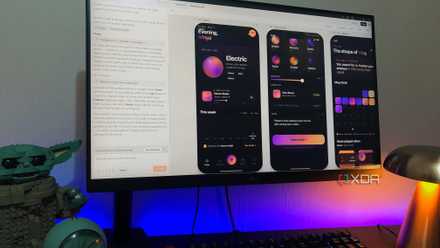
Quant-UX’s biggest selling point is prototyping. Prototypes in Figma are basically clicks of static frames. A dropdown list is a hotspot that jumps to another frame where you open it and does not accept typing entries. In Quant-UX, widgets are real – inputs accept text, dropdowns are actually open, modals overlap correctly, and state can persist across screens. For example, a cart counter that goes from 0 to 1 after clicking the Buy button is an action in Quant-UX. In Figma this would be a separate frame for each carriage state.
You can also run form validation and conditional logic, so when a tester walks through a prototype, the screen they’re using behaves more like a real product than a slideshow. Figma does not have native user testing, even at the paid level. You can plug in third-party tools like Maze, and there’s also the UserTesting Figma plugin, but these are all paid platforms hosted on top.
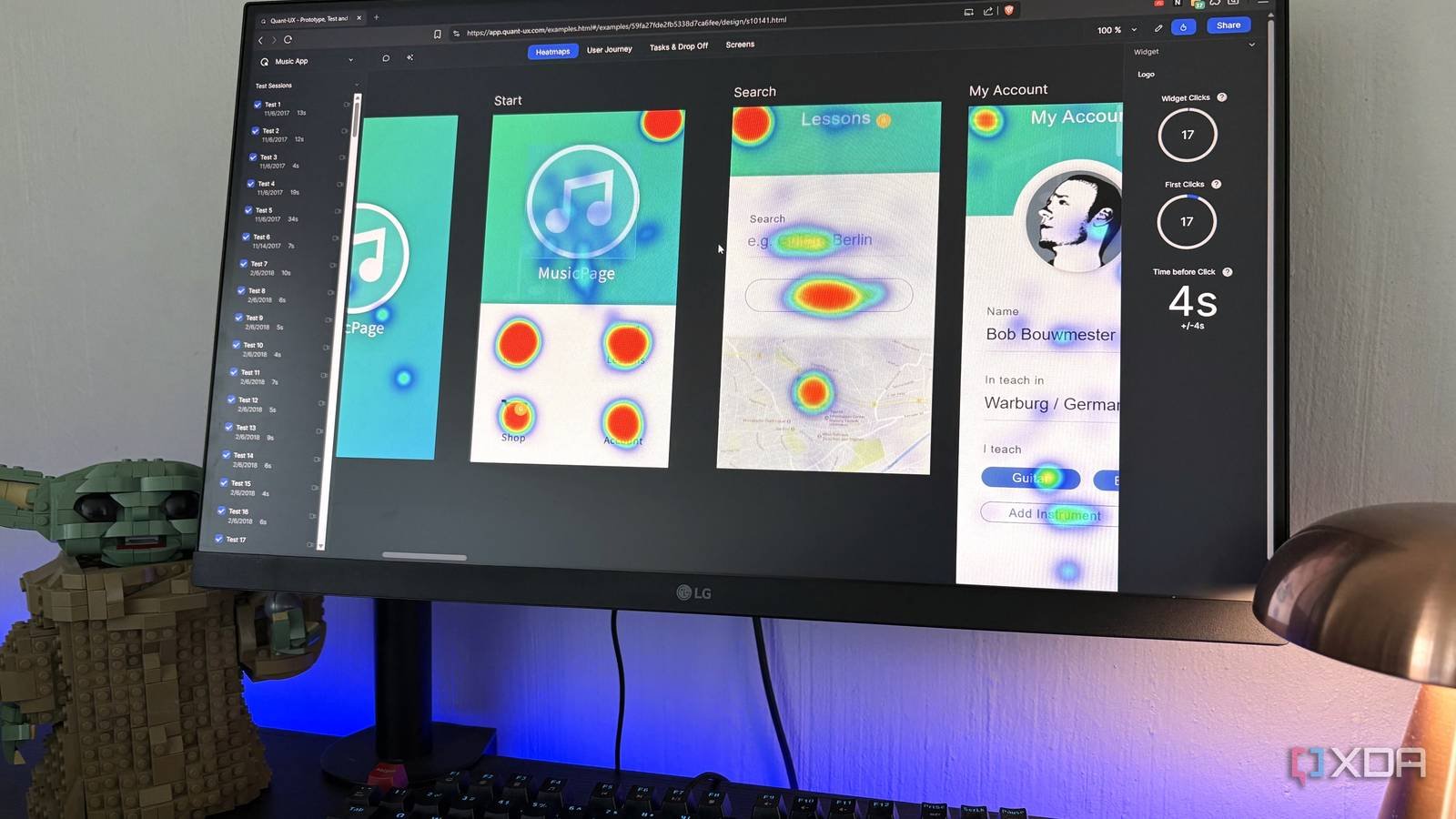
Quant-UX does the whole loop. You define your tasks in advance, share the prototype link with testers, and Quant-UX records every session – clicks, time on screen, where they get stuck, and more. There’s also a built-in A/B test if you want to compare the two versions side-by-side.
The data side is where heatmaps come in. Quant-UX automatically pulls everything from those testing sessions into an analytics canvas, and you can see that data through click heatmaps that show where people are tapping. There are also heatmaps that show which screens are commonly viewed, the time spent on each screen, success rates per task, and the aggregated user journey so you can see common paths versus outliers. You can also take screenshots to track back sessions.
So you’re not just replacing Figma here, you’re replacing Figma plus Maze with one tool, and the analytics are attached to the actual prototype, not in a separate dashboard you have to navigate to. There is no internal tester recruitment, so you bring your own people into testing.
It’s much closer to the real product than what Figman gives you
I think the design canvas could use a little more love, but everything else Quant-UX gives you is really impressive, especially the combination of prototyping and testing that you usually have to pay for in two separate tools. As a design learner, having the entire research part of the design process for free is hard to overestimate.



