
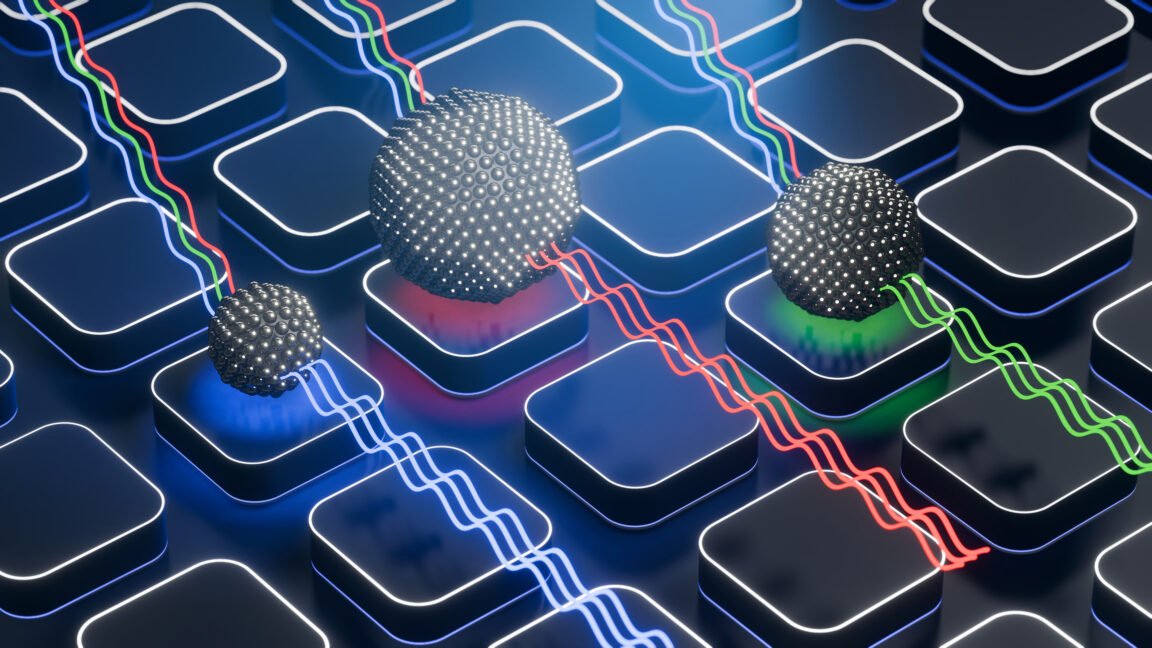
Like any other manufactured chip, the wires connecting the quantum dots are locked in place during the chip’s manufacture. Since different error correction schemes require different connections between qubits, this forces us to follow specific error correction schemes during fabrication. If a better circuit is developed after the chip is made, it probably won’t be possible to switch to it. Less complex algorithms can benefit from simpler error correction circuits with less overhead, but we won’t be able to change the circuits with these chips.
So quantum dots characterize the trade-offs we face with quantum computing: it’s easier for us to create lots of quantum dots and all the hardware we need to manipulate them, but they can’t benefit from the flexibility of other types of qubits.
The whole purpose of this new paper is to show that this is not necessarily true.
Moving points
The new work was carried out as a result of a collaboration between researchers from the Delft University of Technology and the start-up QuTech. The team built a chip with a linear array of quantum dots, and they started with single electron spins at each end. Then, with appropriate electrical signals, they could move the spins to a net point, gradually bringing them closer together. (And by gradual, we mean a fraction of a second here, but relatively slow compared to a fundamental switch in electronics.)
Once the electrons were close enough, the spin wavefunctions overlapped, allowing the researchers to perform two-qubit gates on them. These manipulations can be used to mix the two spins, and thus to create error-corrected logical qubits; these gates are also needed to perform calculations.
The researchers then confirmed that they could move the electrons back to their starting positions, after which measurements confirmed that their spins were entangled. Since quantum teleportation also requires two qubit gates, they showed that this process can be used for teleportation. Teleportation can increase the type of mobility provided by moving qubits, as it can be used to move the state after the qubits are widely separated.



