
TL;DR
OpenAI merged ChatGPT, Codex and its API under Brockman, killing off side projects to focus on an agent platform before its IPO.
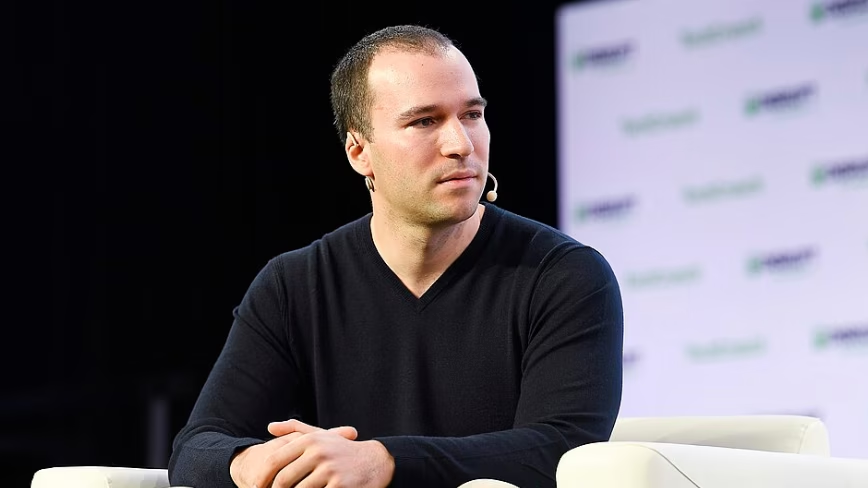
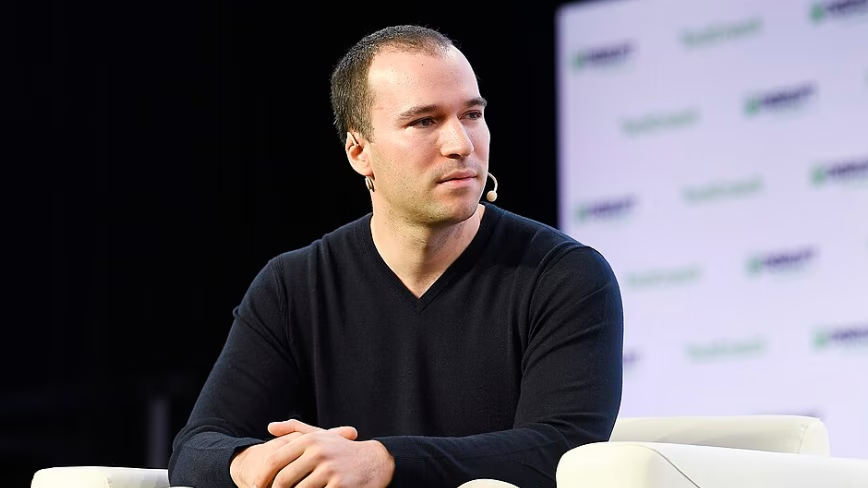
Co-Founder and President of OpenAI Greg Brockman has taken over the company’s product strategy permanentlyConsolidate ChatGPT, Codex, and developer API into a single product organization. In an internal memo seen by Wired, Brockman wrote that OpenAI “invest in a single agent platform and integrate ChatGPT and Codex into a single agent experience for all.” The restructuring formalizes an interim arrangement that began in early April when Fiji Simo, OpenAI’s senior director of AGI deployment, went on medical leave.
The reorganization puts four columns under Brockman. Thibault Sottiaux, the engineer who built Codex into one of OpenAI’s fastest-growing products, now leads the core product and platform across consumer, enterprise, and developer interfaces. Nick Turley, who oversaw ChatGPT’s expansion to more than 900 million weekly active users, is moving into a role focused on enterprise products and critical industries. Brockman retains existing responsibility for the AI infrastructure, including the Stargate data center program. OpenAI told TechCrunch that Simo collaborated with Brockman on these changes and is expected to return, though no timeline has been announced.
The consolidation is the culmination of a strategic retreat announced by CEO Sam Altman in December.red code” and told employees that the company needed to refocus on the core ChatGPT experience. OpenAI has since shut down Soravideo creation software that consumed massive computing resources relative to its revenue and caused the collapse of a planned $1 billion Disney investment. ChatGPT has suspended adult mode following the withdrawal of employees, advisors and investors. Stopped OpenAI for science. Sora CEO Kevin Weil and product lead Bill Peebles have both left. The Company internally describes these discontinued initiatives as “side quests.“
Brockman himself explained in a recent podcast the computational limitation that led to the consolidation, saying that OpenAI’s computing power “not even enough for a personal assistant and Codex line.“When you’re resource constrained, you can’t maintain separate product teams, separate roadmaps, and separate engineering organizations for products converging toward the same capability. Consolidation eliminates this redundancy and concentrates engineering efforts on a single surface that can handle conversation, code generation, tooling, and independent task execution.
The competitive context is immediate. Cursor’s annual revenue has reached 2 billion dollars and the agent is in talks for a $50 billion valuation, demonstrating that coding is the fastest-growing category in developer tools. Anthropic’s Claude Code is popular with enterprise developers. According to SimilarWeb, Google’s Gemini increased its share of web traffic with AI from 5.7% to 21.5% in the last twelve months, while ChatGPT’s share fell from 86.7% to 64.5%. Google I/O 2026 opens on Monday with agent coding and Gemini updates high on the agenda. Two years ago, OpenAI challenged Google I/O by introducing GPT-4o the day before the conference. This year, OpenAI is not opposed to a product launch. Illustrated with an organization chart.
The restructuring is also related to the IPO. OpenAI is set to go public in Q4 2026targeting a valuation of around $852 billion. It’s easier to present a simpler product story to institutional investors than a platform rather than a portfolio of individual programs. It also creates a cleaner revenue story: one subscription tier, one developer platform, one enterprise offering, all built on the same underlying model infrastructure. The previous structure, where Codex served developers and monetized the API ecosystem separately, while ChatGPT tracked consumer coverage, created internal competition for computing, engineering talent, and strategic focus.
The timing is complicated by the lawsuit against Musk AltmanJury selection began Monday in federal court in Oakland. Musk’s lawsuit seeks up to $150 billion in damages and calls for the cancellation of OpenAI’s non-profit conversion. The most damning piece of evidence is Brockman’s own 2017 diary entry: “I can’t believe we’re a non-profit, if we’re doing a b-corp after three months, that’s a lie.” Brockman now also leads OpenAI’s product strategy, oversees the construction of its infrastructure, and serves as a central figure in a test that could determine whether the company’s legal structure survives.
A unified platform that OpenAI internally describes as an agent “super app,” will roll out gradually. Codex ChatGPT and the company’s research tool Atlas will be expanded first to cover productivity tasks outside of coding before folding. A launch date has not been announced. The ambition is a single application where a user can chat, write code, perform multi-step tasks, browse the web, manage files and interact with all external services, all external services and interaction through the same model comes through a single subscription or API billing connection.
Whether one person can manage both product strategy and infrastructure for a company with 900 million weekly users, thousands of employees, a multibillion-dollar data center program and an IPO on the horizon is a question the OpenAI board implicitly answered by giving Brockman both jobs. The answer is that there is no one else they trust to do it. Side quests are over. The rest is the main search: build a platform, send an agent, go public. Everything else is cut.



