

TL; DR
Vytautas Savickas, CEO of Oxylabs, argues that the biggest shift in AI is moving from model performance to infrastructure reliability. As AI enters the agent era, systems need fresh web data, browser automation and real-time access to work in the real world. According to him, the companies that gain artificial intelligence will not necessarily build the biggest models, but the systems that users trust the most.
Thousands of engineers, builders and researchers gather in San Francisco AI Engineer World Expomuch of the conversation has focused on increasingly capable models, autonomous agents, and AI applications.
According to CEO Vytautas Savickas Oxylabsbut the biggest industry shift is happening elsewhere.
“For the past three years, AI has largely been a story about better models.” he says. “The next chapter is about everything around those models: the infrastructure, systems, and live data that enable AI to work in the real world.“
This changes the needs of AI systems.
They no longer rely only on what they learned during training. Increasingly, they depend on fresh data, live search, browser interaction and reliable access to the ever-changing web.
“Knowledge is not static,“Says Mr. Savickas.”Out of touch with fresh information, a model knows less about the world today than most people think. The closer AI gets to real-world decisions, the more important it becomes to stay grounded in reality.“
AI is becoming an infrastructure challenge
According to Mr. Savickas, every major advance in artificial intelligence has fundamentally changed the infrastructure beneath it.
“The first wave was related to the development of foundation models. Everyone needed a lot of different public information.
Then it came search augmented generation (RAG). It wasn’t enough to know that suddenly the world looked like it did yesterday. The AI should have figured out what changed five minutes ago.
Now we enter agency period. AI systems start searching, comparing, checking, buying, tracking and fulfilling tasks on behalf of users.“
According to him, each wave requires a different infrastructure.
“People often think that AI is primarily a model problem. It becomes more and more is an infrastructure problem.“
Public internet data is no longer only used for training. It becomes part of the AI runtime.
“The Internet was created for billions of people. We’re now asking it to support billions of AI-driven interactions. This fundamentally changes what the infrastructure needs to deliver.“
Building for AI before AI
Long before the underlying models became mainstream, Oxylabs was building the infrastructure that enabled enterprises to securely access and operationalize data from the public Internet.
“It may appear that AI created this market overnight,“Says Mr. Savickas.”Actually, the AI didn’t create this problem. It exposed him to a whole new level.“
For years, businesses have depended on ever-changing data for e-commerce, cybersecurity, travel, finance and market intelligence. Artificial intelligence has simply extended these requirements to almost every industry.
Today, Oxylabs serves more than 15,000 customers worldwide, holds more than 160 patents, and operates one of the world’s largest public Internet data infrastructures.
Intelligence alone will not determine who wins in AI
Much of today’s AI conversation still revolves around model performance.
Mr. Savickas believes the debate is beginning to change.
“Boundary models will continue to improve, but for many real-world applications, model quality alone is no longer a differentiator. Increasingly important is how securely AI systems connect to the outside world.“
This change also changes the way he thinks about hallucinations.
“A model is not necessarily inventing something because it is irrational. It often tries to justify using old, incomplete or unverified information.“
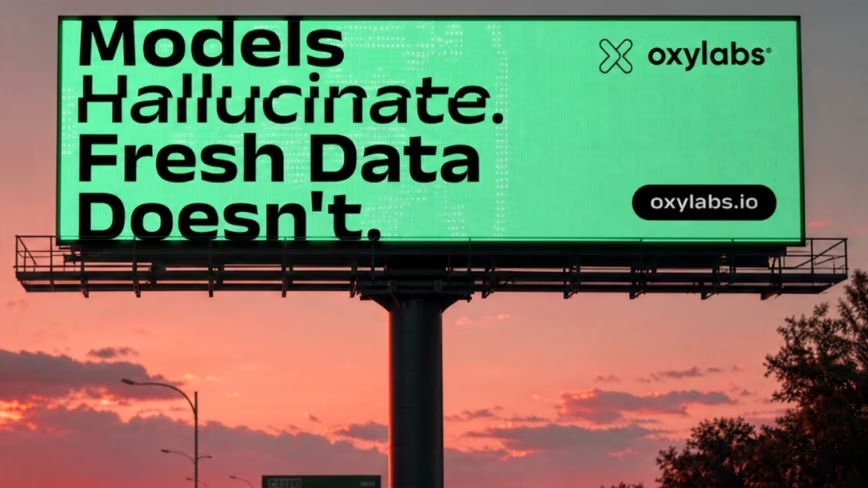
Visitors to the AI Engineer World Expo can see one of Oxylabs’ messages in San Francisco: Models Hallucinate. No New Data.
“It’s deliberately simple,“Says Mr. Savickas.”But it captures something fundamental. Artificial intelligence needs more than just thinking. It needs reality.“
According to him, this will redefine competition in the AI industry.
“Companies that win AI won’t necessarily build the biggest models. They will build the systems that users trust the most.“
AI agents are changing everything
The rise of artificial intelligence agents is also changing the way engineers think about infrastructure.
Logic is only part of the problem.
Artificial intelligence systems must increasingly navigate websites, authenticate, verify information, compare alternatives and perform actions reliably.
“Everyone is talking today Creating AI agents,“Says Mr. Savickas.”Tomorrow everyone will ask why those agents fail?“
“In many cases, the answer won’t be the model. It will be the infrastructure that connects that model to the real world.”
According to him, this is where most of the artificial innovation is happening now.
“Delay is important. Credibility is important. Browser automation is essential. None of these make headlines, but they all determine if the AI actually works.“
More hype, same engineering realities
The rapid development of artificial intelligence has introduced a new generation of companies building tools around it browser automationagent frameworks and web access.
Mr. Savickas welcomes the speed.
“It’s exciting to see developers realizing how important this layer of technology is.“
At the same time, he believes that AI has changed the language around long-term engineering problems rather than the problems themselves.
“Each wave of technology creates new terminology. Engineering problems are often more familiar than they seem.“
“It’s not the label that matters. What matters is that your infrastructure works reliably when thousands of AI systems depend on it.“
Keeping the web open
As artificial intelligence systems become increasingly dependent on publicly available data, the debate over internet access continues to grow.
For Mr. Savickas, maintaining an accessible open internet is important not just for AI companies, but for innovation itself.
“The open web remains humanity’s greatest shared knowledge resource because information can be discovered, combined, and built upon.“
“If information is intentionally made public, it must remain available. Researchers innovate, businesses compete, and new technologies emerge.“
Looking beyond today’s AI boom
With nearly a decade spent building the infrastructure for public Internet-enabled enterprises, Oxylabs has already seen several technology waves reshape the industry, from travel aggregators and digital marketing to e-commerce, cybersecurity and now artificial intelligence.
Artificial intelligence may be the biggest wave yet, but Mr Savickas believes it won’t be the last.
“The first generation of artificial intelligence proved that machines can think.“
“The next challenge is to make those systems work reliably in the real world.“
“AI won’t just come with better models. It will be equipped with better infrastructure around those models.“



