

The Japanese group plans to mass-produce data center battery cells in Kansas by fiscal 2028, channeling a large portion of its AI infrastructure investment into storage.
Companies that make batteries for electric vehicles are discovering a new and hungrier customer: the data center.
Panasonic plans to localize production of data center battery cells in the U.S., the chief executive of its power unit said, as the Japanese group chased a market that almost didn’t exist a few years ago, building the cells in a plant in Kansas instead of shipping them.
Mass production at the Kansas site is scheduled for the fiscal year ending in March 2029, which Panasonic considers fiscal 2028.
The plant gives the company a local base to directly supply American data center operators, a significant advantage at a time when tariffs, supply chain concerns and the speed of creating artificial intelligence have become more of a competitive asset than a cost to minimize onshore production.
The money behind the move is huge. Of Panasonic’s previously announced 500 billion yen AI infrastructure investment for fiscal 2026-2028, about 350 billion yen, about $2.18 billion, will go to the Energy division, which supplies Tesla, and the remaining 150 billion yen to the Industrial segment.
The split gives you a sense of where the company’s growth lies: the battery business that grew around electric vehicles is being restructured to feed the server room.
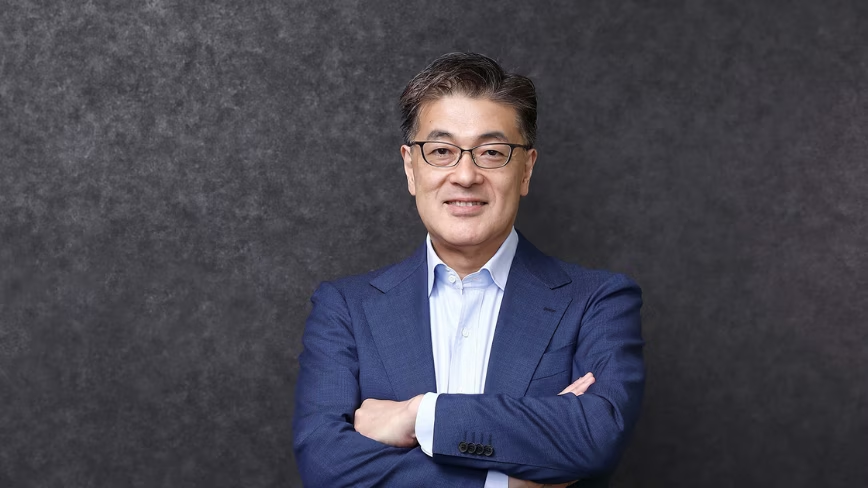
Ambition is measured accordingly. Panasonic Energy CEO Kazuo Tadanobu said the unit’s sales target of ¥950 billion for data center-related energy storage in fiscal 2028 was “minimum commitment” with the business aiming to surpass 1 trillion yen in sales.
Framing the target as a floor rather than a goal is a sign of how quickly the company expects demand to pick up.
The logic is based on how modern data centers actually work. The devices that train and service AI models draw huge, spiky loads, and they can’t tolerate even the slightest interruption, making large-scale battery storage essential to smooth out supply, eliminate outages, and manage the gap between what the grid can deliver and what the racks demand. As AI scales up computing, the memory attached to it scales along with it.
The cells these devices need are also of different specifications than those found in cars, tuned for grid-type duty cycles rather than the vehicle’s range and weight limitations, which is part of the reason the established battery manufacturer still has to create custom capacity rather than modify existing lines.
This demand is already straining the systems around it. The installation pushed operators’ power grids to their limits Denmark suspends new ties China is grappling with how to match clean power with data center load.
Batteries become part of the AI’s core plumbing, not an add-on that is bolted on at the end.
Panasonic doesn’t go into a vacuum. Chinese battery giants, including CATL, compete in the same data center storage market, and the competition goes hand in hand with broader competition over silicon inside these facilities, which Chinese firms are pushing. Native alternatives to Nvidia rapidly.
The power layer of the AI stack is becoming as controversial as the compute layer.
The US plant is a node in a wider network. Panasonic Energy is also planning a third plant in Mexico, with mass production similarly slated for fiscal 2028, giving it North American capacity on both sides of the border.
The company did not detail the Kansas site’s production volumes or name the data center customers it expects to serve, with commercial specifics to emerge closer to production.
What is clear is the direction: a battery maker that has tied its future to cars is now making a second bet on machines that learn to think.



