

Sandhoo identified several issues with the first Tranche 1 satellites during a roundtable with journalists ahead of this week’s launch. Ground controllers did not have enough ground station coverage to communicate with the satellites after last year’s launches. Sandhoo said some of the satellites experienced problems with their thermal control and propulsion system as they climbed from their orbit to an operating altitude of more than 600 miles (1,000 kilometers), significantly higher than SpaceX’s Starlink Internet network.
“We’re in a pretty harsh radiation environment at 1,000 kilometers, so the whole ascent of our orbit didn’t go according to plan,” he said. “It’s been sporadic. We’re working on it.” Sandhoo is optimistic that ground teams will eventually declare most of the satellites ready for operations, but it is taking longer than expected.
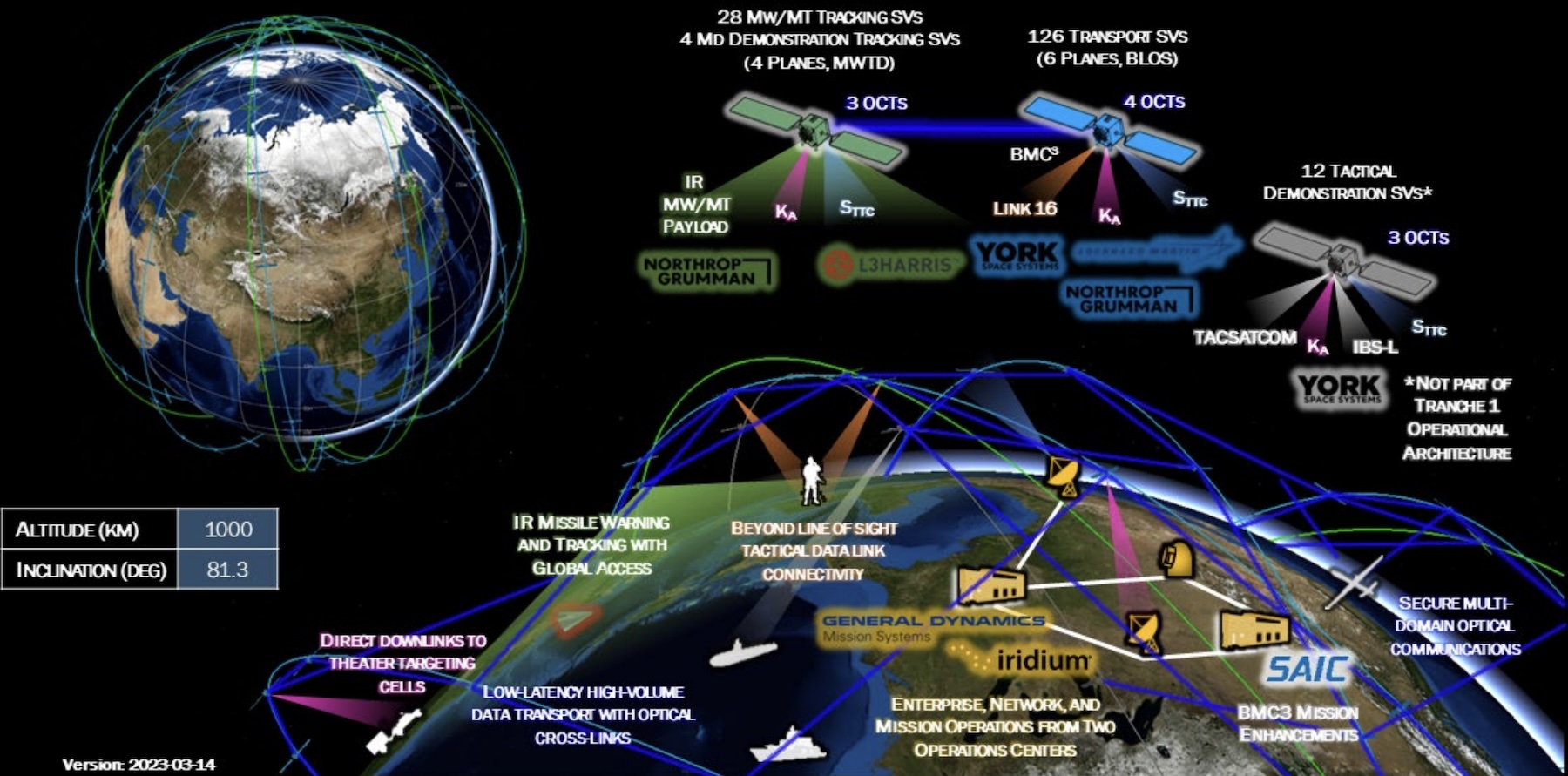
The Tranche 1 architecture of the Space Development Agency includes 154 operational satellites, 126 satellites for data transmission and 28 satellites for missile tracking. With this description, SDA does its best to show how it should work.
Credit: Space Development Agency
The Tranche 1 architecture of the Space Development Agency includes 154 operational satellites, 126 satellites for data transmission and 28 satellites for missile tracking. With this description, SDA does its best to show how it should work.
Credit: Space Development Agency
Get it right
After last year’s launch, the SDA and its contractors “at least took a break to make sure we addressed the known issues,” Sandhoo said. “We expect this release to be smoother than the previous one.”
Thursday’s launch was the second SDA launch of York’s data carrier satellites and the third for Tranche 1 overall. Seven more launches will complete the Tranche with 63 additional data carrier satellites and 28 missile tracking satellites produced by Lockheed Martin, Northrop Grumman and L3Harris. None of the Tranche 1 tracking satellites have been launched yet.
Sandhoo said the schedule for the next series of SDA satellites is “still limited” by the availability of the optical communication terminals, laser transmitters and receivers needed to connect the transport and tracking satellites into a single network network.
While SDA officials declined to say when the next few launches might occur, the agency said the Tranche 1 satellites “will provide initial combat capability starting in 2027. Sandhoo said the agency is no longer focused on achieving a monthly launch cadence. It’s more important, he said, to make sure SDA launches are ready as soon as possible after orbit.”



