As a young guy, before I got serious about networking, I would spend hours optimizing my desktop computer. This will involve adjusting BIOS settings, benchmarking, and countless system reboots. Over time, I would acquire new hardware to replace old components, but one thing would always remain constant: the Ethernet cable. In 2005, I would never change the actual cable that carried data between my router and my computer, the only wired device on my network. To this day, I still have a lot of old cables, some of them more than ten years old.
Over the years I upgraded from ADSL to full fiber. I’ve also collected more technology with various appliances and devices, many of which require internet access. What I didn’t expect with all of this was how much of an effect a bad Ethernet cable can have on a LAN. I was still relying on a Cat5e cable between one of my switches, a network NAS, and my desktop computer. after replacing both with Cat6a cablesthe difference was immediate and night and day.
I assumed the problem was with the ISP
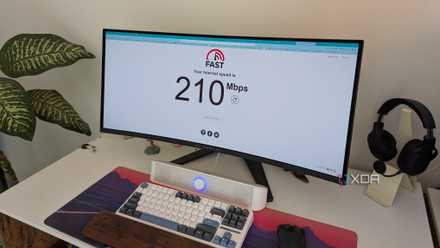
My speed tests never matched what I paid for

British Telecom (BT) was rock solid for many years and after finally switching to Zen I always thought I’d lose speed due to network congestion out of my control. There’s always a “minimum guaranteed” speed, which can sometimes be 20% or less than the maximum advertised speed you’re actually paying for. There is always a cap because you pay “up” to that speed. Some ISPs are reliable enough to offer these speeds consistently, but most are not.
The performance wasn’t terrible. These Cat5e cables were still good for carrying lots of data over a LAN. Since it was affecting my PC and NAS the most, I thought it was ISP related, since I wasn’t really paying attention to maximizing the throughput between the network storage and the rest of the LAN. Everything changed when we took networking seriously and finally decided to upgrade the entire network with the best hardware and services. Everything we do these days is online, so it only made sense to get the background right.
I also write about this every day, so I definitely have to practice what I preach. My custom OPNsense firewall It has 2.5GbE network portslike all my switches and I use 10Gb trunking between switches so internal bandwidth shouldn’t be an issue. As my internal network performance is limited to a 1Gbps fiber plan, it should exceed what is possible with external speed tests. What I wasn’t ready for was the realization I was still using Cat5e cable and old wiring.
A quick check revealed the real bottleneck
Parts of the network weren’t working as fast as I thought they would
The breakthrough came when I stopped focusing on internet speed tests and started testing the local network connection itself. Instead of trying to find out how fast my internet is, I checked how fast my computer and router were communicating with each other. That’s when everything started to come together. I realized that my network connection is not working at the highest speed supported by my hardware.
After making sure that both ends of the cables were indeed connected to the 2.5GbE ports, I ran some tests on my computer to see if anything was messing up the system or connection. Linux only reported 1Gbps throughput. Now, this is either a problem with the network interface card (NIC) on the motherboard, which can happen, or the cable is simply not up to speed. The cable looked good physically with no kinks or other damage. Seeing that it was an old Cat5e cable, I took a Cat6a cable from another port on the switch and used that instead.
The difference was immediate. After reconnecting everything, my computer negotiated a higher transfer speed without any additional configuration. Running another set of speed tests showed significantly better results than before, with large downloads completed noticeably faster. It was a shock that I hadn’t seen this before, but even 1Gbps is still pretty fast by modern standards. I bought two new Cat6e cables and replaced the one between the NAS and the switch. The same improvements were experienced there.
The problem with the LAN was based on outdated and old cables. After the change, the rest of the network can finally work as intended. Switching to Cat6A cable won’t automatically speed up every network, but if you’re like me and continue to use any old random cable that’s been plugged into devices over the years, you’ll start to see problems increasing speeds. After this was done, I replaced the entire network stack with brand new cables (all Cat6a for the nodes).
The smallest components can still limit the entire system
When configuring advanced hardware, networks, and features, it’s easy to overlook some of the more fundamentals. An Ethernet cable is much like the tires of a car. A car is only as capable as the rubber that binds it to the road. The same goes for network devices. They will only communicate as quickly (and reliably) as the cables allow. Sometimes the most effective improvement is not the most expensive; it’s simply identifying and removing a bottleneck that already exists.