

Light collection, data decoding
At a high level, the concept is fairly simple. The spacecraft encodes the data into a laser that sends a narrow beam back to Earth. Large optical telescopes on the ground collect the incoming photons, and detectors convert the light back into electrical signals. Sophisticated error correction software reconstructs the original message because many photons are lost.
The greater the distance, the harder the problem. A laser beam from a geostationary orbit about 22,000 miles (36,000 km) above Earth starts out about the diameter of a coffee cup and is about 1 km wide by the time it reaches Earth. The farther it is, the farther the beam spreads, so ground-based telescopes can pick up only a small fraction of the signal from distant spacecraft.
So the future of communication in all the heavens will probably be based on relay spacecraft, which are like Internet routers on Earth. “We will build space-deployed systems and become a fiber-optic communications infrastructure throughout the solar system,” Roelker said.
That’s the view, at least.
But it is starting to happen. Observable Space played a key role In facilitating optical communications during the Artemis II flyby around the Moon in April. This type of high-throughput communication is expected to be the standard for future Artemis missions, allowing for high-precision lunar landings.
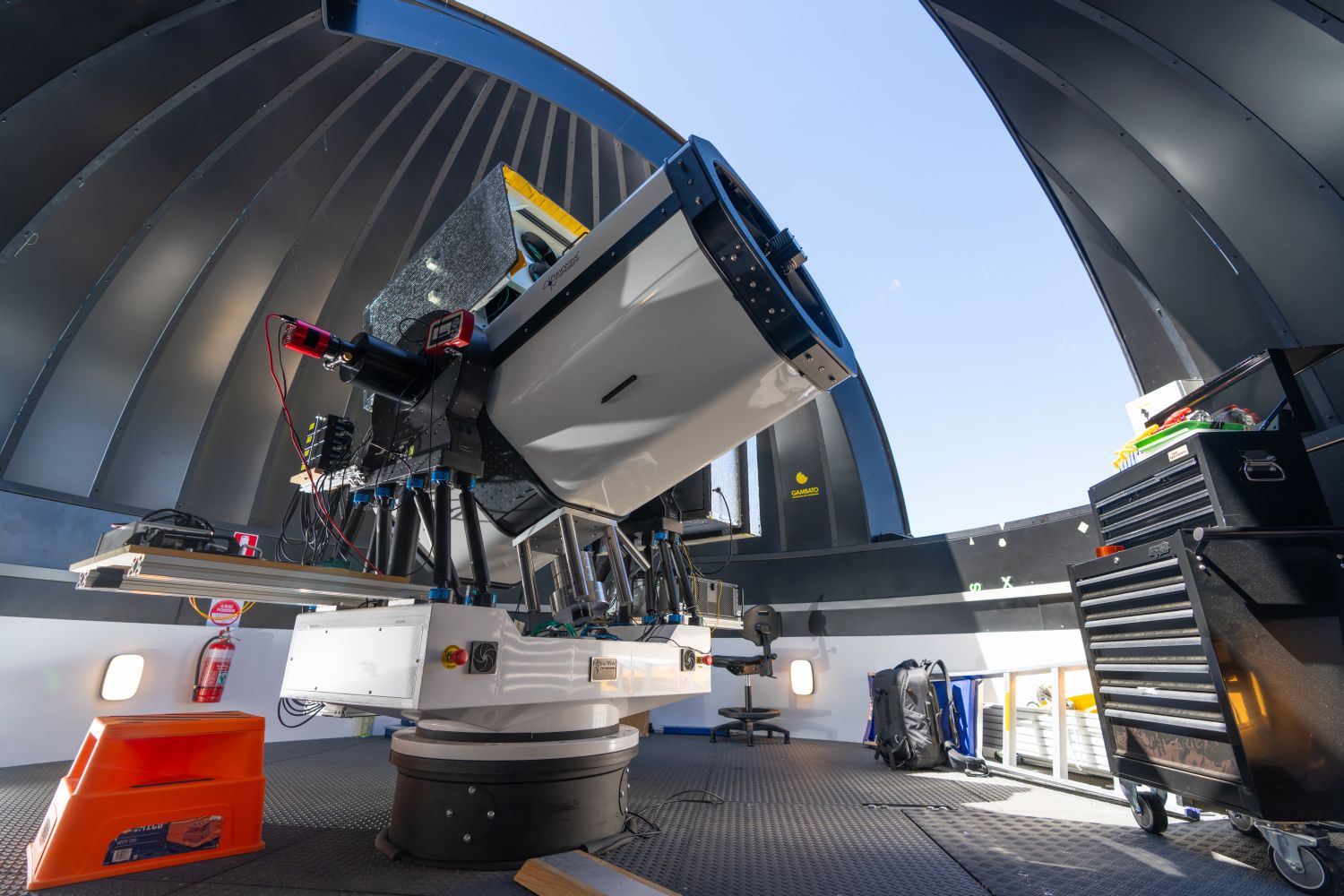
The Australian National University, Canberra, ACT, Australia, provided space-to-ground laser communications for Artemis II with its laser-optimized system, Observed Space RC700 at Mount Stromlo Observatory, Australia.
Credit: Nic Vevers/ANU
The Australian National University, Canberra, ACT, Australia, provided space-to-ground laser communications for Artemis II with its laser-optimized system, Observed Space RC700 at Mount Stromlo Observatory, Australia.
Credit: Nic Vevers/ANU
Observable Space is also talking to SpaceX and anyone interested in developing orbital data centers, as this technology requires high bandwidth from space to ground. And the way to get around the clouds is to have many ground stations around the planet. For this reason, Observable Space is focused on expanding telescope production and reducing costs.
Investors are buying. In late May, the company announced that it had closed a $90 million Series A funding round, which it will use primarily to accelerate its laser communications business.
Roelker is happy to leave space launches to other companies. He saw SpaceX from the inside and knows he can never compete with it. Similarly, there are many companies that manufacture spacecraft and satellite buses.
All these machines need is the command of light. Rockets, especially spacecraft, need it for navigation. They must see objects to avoid collisions. And somehow, they have to bring them back to Earth with all the data they’ve collected and processed. Because, otherwise, what’s the point?



